News & Updates

What's Happening at Springhill Family? Find it all here.
By subscribing, you agree to receive email communication from Springhill Family. You can unsubscribe at any time.

Featured
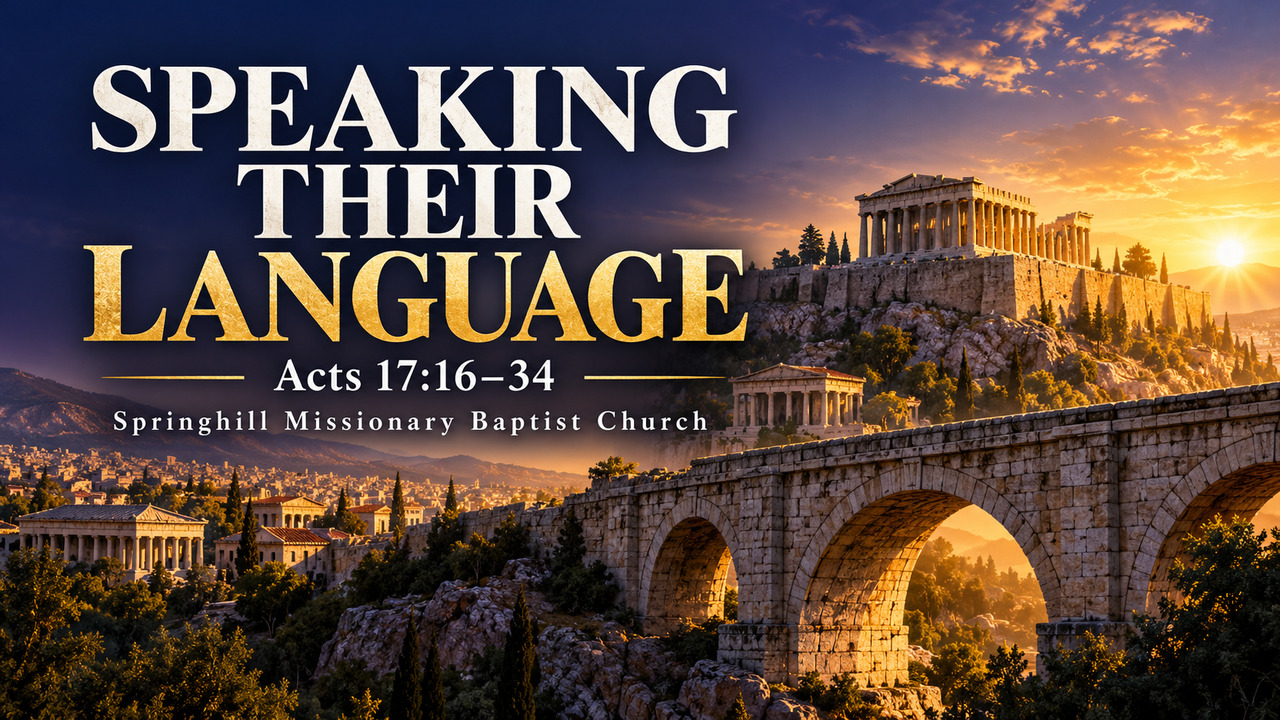
Speaking Their Language: How to Share the Gospel With Anyone

Sharing the gospel is one of the most important things a Christian can do, but it is also one of the most misunderstood. Many believers know what they believe, but struggle to communicate it in a way that actually connects with the people around them. The truth does not change, but the way we deliver it must meet people where they are. Why Does Sharing the Gospel Feel So Hard? The challenge is not the message itself. The challenge is the language. When a missionary travels to a foreign country and preaches without an interpreter, it does not matter how sound the doctrine is or how passionately it is delivered. If the people cannot understand the language, the message falls on deaf ears. The same principle applies right here at home. Every person you encounter is coming from a different place, carrying different questions, different wounds, and different beliefs. That means they are often speaking a different language, even if the words sound familiar. The gospel does not change. But the language must. What Can We Learn From Paul in Athens? In Acts 17, the apostle Paul finds himself in Athens waiting for his companions Silas and Timothy. Athens was a city filled with philosophy, intellectual debate, and devotion to many idol gods. It was a culture that shared none of Paul's biblical foundation. Rather than retreating, Paul leaned in. He went to the synagogue. He went to the marketplace. He engaged with philosophers who thought he had no idea what he was talking about. Eventually, he was brought to the Areopagus, a hill named after the Greek God of war, to explain His message to people who worshiped false gods. And that is exactly where he chose to speak. There are three lessons from this passage that every believer can carry into their daily life. Lesson One: Observe People Before You Address People Paul did not walk into Athens with a prepared script and deliver it regardless of his audience. He paid attention. He walked around, looked at the altars, studied the culture, and noticed something remarkable. Among all the shrines to various gods, there was one altar with an inscription that read: "To the Unknown God." Paul did not have to invent an opening. He simply paid attention to what was already there. Sometimes we miss opportunities to share the gospel because we are so focused on what we want to say that we never stop to hear what people are actually saying. We have a script in our heads, and no matter what someone shares with us, we are going to deliver our point regardless. Effective gospel sharing begins with a willingness to listen before speaking, to ask before assuming, and to understand someone's beliefs before trying to correct them. There are people all around us who are already asking spiritual questions. Someone says they do not know what they are supposed to do with their life. Someone wonders if anyone truly loves them. Someone is searching for peace in the middle of chaos. Someone is looking for community but running to all the wrong places to find it. All of those longings are open doors. But we walk right past them because we are too busy preparing our presentation to notice the person standing in front of us. What Does Observation Require? Observation requires humility. You cannot assume you understand someone's story because you have observed their behavior. You cannot look at how someone dresses, how they talk, or how they move and think you know everything about them. Humility means listening with compassion while remaining committed to biblical truth. It means asking sincere questions even when those questions might lead to conflict or to answers you do not have. Lesson Two: You Can Build a Bridge Without Changing the Destination Once Paul identified that point of connection, the altar to the unknown God, He began to build a bridge. He said, in effect, "You have acknowledged a God you do not know. Let me introduce you to Him." He declared in Acts 17:24-25 that God made the world and everything in it, that He does not live in temples built by human hands, and that He does not need anything from us because He is the one who gives life and breath to everyone. Paul took their religious activity and built a bridge from it to the character of the living God. He even quoted their own poets, saying in Acts 17:28, "For in him we live and move and have our being, as even some of your own poets have said, for we are indeed his offspring." He used language familiar to them to communicate a truth that was completely new to them. He was aware of the culture without being controlled by it. What Makes a Bridge Structurally Sound? A bridge has to be functional first. It does not matter how beautiful it looks if it cannot hold the weight of what it is carrying. The gospel we share must be structurally sound. The foundation must be sure before anything else is added. And here is the critical point: speaking a different language does not mean saying a different thing. It means saying the same thing in a different way. There is a real danger in wanting so badly to connect with people that we compromise the message. Some people want to build a bridge so much that they leave out the parts of the gospel that might make someone uncomfortable. But if we tell people that God loves them without explaining salvation, the message is incomplete. If we say Jesus is an inspiration but never proclaim Him as the crucified and risen Savior, we are building a bridge that only goes halfway. You cannot cross a bridge that is not finished. Paul did not stop at empathy. He did not stop at cultural connection. He took the conversation all the way to the resurrection, the judgment of God, and the call to repent. He met people where they were because he cared deeply about where they were going. Are We Too Disconnected From the People We Are Trying to Reach? To build a bridge, you have to know where people are starting from. If we spend all of our time surrounded by like-minded people and go out of our way to avoid those who think or live differently, we will not know how to speak their language. We will hand someone a card and invite them to church without ever understanding what they are actually going through. We cannot get so comfortable in our church culture that we forget what it felt like to struggle, to search, or to not have the answers. The moment we start looking down at people from a distance, we lose the ability to build anything that connects. Lesson Three: Your Faithfulness Is Not Measured by Everyone's Response Even when we observe carefully and communicate faithfully, we cannot control how people respond. Paul proclaimed the resurrection of the dead, and the responses were all over the map. Some mocked him. Some said they wanted to hear more. And some joined him and believed. Same message. Same moment. Completely different responses. Rejection does not mean failure. Jesus Himself was rejected by people who heard Him speak in person and watched Him perform miracles. John 6:66 tells us that after hearing His teaching, many of His followers turned back and no longer walked with Him. Jesus did not change His message to keep the crowd. If people rejected Jesus, they will reject us too. Because we are not sharing ourselves. We are sharing Jesus. How Do We Handle Rejection When Sharing Our Faith? Public rejection can be discouraging, but it should not be a deterrent. Notice that Acts 17 does not end with the mockers. It ends with those who joined Paul and believed. The mockers did not prevent the believers. Do not allow the people who refuse to listen to distract you from the people who are ready to hear. If you spend all your time arguing with those who are determined to reject the message, you will never reach the ones who are genuinely hungry for it. Say what you have to say. Share the word. And let God do the rest. The World Is Changing. The Message Is Not. Language is changing. Culture is changing. The questions people are asking are changing faster than ever. But Jesus is the same yesterday, today, and forever. The challenge for every believer is to communicate that unchanging Jesus in as many languages as possible. That means being willing to meet people in their confusion without getting frustrated. It means entering into their search for purpose without acting like we have everything figured out. It means sitting with people in their pain and pointing them, through the word of God, to the one who can actually heal it. We must learn the language without losing the message. We must build the bridge without changing the destination. And we must keep pointing people to Jesus, no matter how many times we are turned away. Life Application This week, before you try to share your faith with someone, commit to listening first. Find one person in your life who does not share your beliefs or who is clearly searching for something, and instead of leading with what you want to say, ask them a genuine question about their life and actually listen to the answer. Pay attention to what they are really asking underneath the surface. Then, when the moment is right, build a bridge from where they are to the truth of who God is. Ask yourself these questions as you go into the week: - Am I so focused on delivering my message that I am missing the questions the people around me are already asking? - Have I become so comfortable in church culture that I have lost the ability to speak the language of people who are still searching? - Am I letting fear of rejection keep me from sharing the gospel with someone who genuinely needs to hear it? - When I share my faith, am I giving people the full message, or am I building a bridge that only goes halfway? The people around you are hungry. Some of them do not even know what they are hungry for. Be the one who offers them living water and the bread of life, spoken in a language they can actually receive.Sharing the gospel is one of the most important things a Christian can do, but it is also one of the most misunderstood. Many believers know what they believe, but struggle to communicate it in a way that actually connects with the people around them. The truth does not change, but the way we deliver it must meet people where they are. Why Does Sharing the Gospel Feel So Hard? The challenge is not the message itself. The challenge is the language. When a missionary travels to a foreign country and preaches without an interpreter, it does not matter how sound the doctrine is or how passionately it is delivered. If the people cannot understand the language, the message falls on deaf ears. The same principle applies right here at home. Every person you encounter is coming from a different place, carrying different questions, different wounds, and different beliefs. That means they are often speaking a different language, even if the words sound familiar. The gospel does not change. But the language must. What Can We Learn From Paul in Athens? In Acts 17, the apostle Paul finds himself in Athens waiting for his companions Silas and Timothy. Athens was a city filled with philosophy, intellectual debate, and devotion to many idol gods. It was a culture that shared none of Paul's biblical foundation. Rather than retreating, Paul leaned in. He went to the synagogue. He went to the marketplace. He engaged with philosophers who thought he had no idea what he was talking about. Eventually, he was brought to the Areopagus, a hill named after the Greek God of war, to explain His message to people who worshiped false gods. And that is exactly where he chose to speak. There are three lessons from this passage that every believer can carry into their daily life. Lesson One: Observe People Before You Address People Paul did not walk into Athens with a prepared script and deliver it regardless of his audience. He paid attention. He walked around, looked at the altars, studied the culture, and noticed something remarkable. Among all the shrines to various gods, there was one altar with an inscription that read: "To the Unknown God." Paul did not have to invent an opening. He simply paid attention to what was already there. Sometimes we miss opportunities to share the gospel because we are so focused on what we want to say that we never stop to hear what people are actually saying. We have a script in our heads, and no matter what someone shares with us, we are going to deliver our point regardless. Effective gospel sharing begins with a willingness to listen before speaking, to ask before assuming, and to understand someone's beliefs before trying to correct them. There are people all around us who are already asking spiritual questions. Someone says they do not know what they are supposed to do with their life. Someone wonders if anyone truly loves them. Someone is searching for peace in the middle of chaos. Someone is looking for community but running to all the wrong places to find it. All of those longings are open doors. But we walk right past them because we are too busy preparing our presentation to notice the person standing in front of us. What Does Observation Require? Observation requires humility. You cannot assume you understand someone's story because you have observed their behavior. You cannot look at how someone dresses, how they talk, or how they move and think you know everything about them. Humility means listening with compassion while remaining committed to biblical truth. It means asking sincere questions even when those questions might lead to conflict or to answers you do not have. Lesson Two: You Can Build a Bridge Without Changing the Destination Once Paul identified that point of connection, the altar to the unknown God, He began to build a bridge. He said, in effect, "You have acknowledged a God you do not know. Let me introduce you to Him." He declared in Acts 17:24-25 that God made the world and everything in it, that He does not live in temples built by human hands, and that He does not need anything from us because He is the one who gives life and breath to everyone. Paul took their religious activity and built a bridge from it to the character of the living God. He even quoted their own poets, saying in Acts 17:28, "For in him we live and move and have our being, as even some of your own poets have said, for we are indeed his offspring." He used language familiar to them to communicate a truth that was completely new to them. He was aware of the culture without being controlled by it. What Makes a Bridge Structurally Sound? A bridge has to be functional first. It does not matter how beautiful it looks if it cannot hold the weight of what it is carrying. The gospel we share must be structurally sound. The foundation must be sure before anything else is added. And here is the critical point: speaking a different language does not mean saying a different thing. It means saying the same thing in a different way. There is a real danger in wanting so badly to connect with people that we compromise the message. Some people want to build a bridge so much that they leave out the parts of the gospel that might make someone uncomfortable. But if we tell people that God loves them without explaining salvation, the message is incomplete. If we say Jesus is an inspiration but never proclaim Him as the crucified and risen Savior, we are building a bridge that only goes halfway. You cannot cross a bridge that is not finished. Paul did not stop at empathy. He did not stop at cultural connection. He took the conversation all the way to the resurrection, the judgment of God, and the call to repent. He met people where they were because he cared deeply about where they were going. Are We Too Disconnected From the People We Are Trying to Reach? To build a bridge, you have to know where people are starting from. If we spend all of our time surrounded by like-minded people and go out of our way to avoid those who think or live differently, we will not know how to speak their language. We will hand someone a card and invite them to church without ever understanding what they are actually going through. We cannot get so comfortable in our church culture that we forget what it felt like to struggle, to search, or to not have the answers. The moment we start looking down at people from a distance, we lose the ability to build anything that connects. Lesson Three: Your Faithfulness Is Not Measured by Everyone's Response Even when we observe carefully and communicate faithfully, we cannot control how people respond. Paul proclaimed the resurrection of the dead, and the responses were all over the map. Some mocked him. Some said they wanted to hear more. And some joined him and believed. Same message. Same moment. Completely different responses. Rejection does not mean failure. Jesus Himself was rejected by people who heard Him speak in person and watched Him perform miracles. John 6:66 tells us that after hearing His teaching, many of His followers turned back and no longer walked with Him. Jesus did not change His message to keep the crowd. If people rejected Jesus, they will reject us too. Because we are not sharing ourselves. We are sharing Jesus. How Do We Handle Rejection When Sharing Our Faith? Public rejection can be discouraging, but it should not be a deterrent. Notice that Acts 17 does not end with the mockers. It ends with those who joined Paul and believed. The mockers did not prevent the believers. Do not allow the people who refuse to listen to distract you from the people who are ready to hear. If you spend all your time arguing with those who are determined to reject the message, you will never reach the ones who are genuinely hungry for it. Say what you have to say. Share the word. And let God do the rest. The World Is Changing. The Message Is Not. Language is changing. Culture is changing. The questions people are asking are changing faster than ever. But Jesus is the same yesterday, today, and forever. The challenge for every believer is to communicate that unchanging Jesus in as many languages as possible. That means being willing to meet people in their confusion without getting frustrated. It means entering into their search for purpose without acting like we have everything figured out. It means sitting with people in their pain and pointing them, through the word of God, to the one who can actually heal it. We must learn the language without losing the message. We must build the bridge without changing the destination. And we must keep pointing people to Jesus, no matter how many times we are turned away. Life Application This week, before you try to share your faith with someone, commit to listening first. Find one person in your life who does not share your beliefs or who is clearly searching for something, and instead of leading with what you want to say, ask them a genuine question about their life and actually listen to the answer. Pay attention to what they are really asking underneath the surface. Then, when the moment is right, build a bridge from where they are to the truth of who God is. Ask yourself these questions as you go into the week: - Am I so focused on delivering my message that I am missing the questions the people around me are already asking? - Have I become so comfortable in church culture that I have lost the ability to speak the language of people who are still searching? - Am I letting fear of rejection keep me from sharing the gospel with someone who genuinely needs to hear it? - When I share my faith, am I giving people the full message, or am I building a bridge that only goes halfway? The people around you are hungry. Some of them do not even know what they are hungry for. Be the one who offers them living water and the bread of life, spoken in a language they can actually receive.


• 18 Minute Read
November 1, 2026 • 18 Minute Read
Speaking Their Language: How to Share the Gospel With Anyone
Sharing the gospel is one of the most important things a Christian can do, but it is also one of the most misunderstood. Many believers know what they believe, but struggle to communicate it in a way that actually connects with the people around them. The truth does not change, but the way we deliver it must meet people where they are. Why Does Sharing the Gospel Feel So Hard? The challenge is not the message itself. The challenge is the language. When a missionary travels to a foreign country and preaches without an interpreter, it does not matter how sound the doctrine is or how passionately it is delivered. If the people cannot understand the language, the message falls on deaf ears. The same principle applies right here at home. Every person you encounter is coming from a different place, carrying different questions, different wounds, and different beliefs. That means they are often speaking a different language, even if the words sound familiar. The gospel does not change. But the language must. What Can We Learn From Paul in Athens? In Acts 17, the apostle Paul finds himself in Athens waiting for his companions Silas and Timothy. Athens was a city filled with philosophy, intellectual debate, and devotion to many idol gods. It was a culture that shared none of Paul's biblical foundation. Rather than retreating, Paul leaned in. He went to the synagogue. He went to the marketplace. He engaged with philosophers who thought he had no idea what he was talking about. Eventually, he was brought to the Areopagus, a hill named after the Greek God of war, to explain His message to people who worshiped false gods. And that is exactly where he chose to speak. There are three lessons from this passage that every believer can carry into their daily life. Lesson One: Observe People Before You Address People Paul did not walk into Athens with a prepared script and deliver it regardless of his audience. He paid attention. He walked around, looked at the altars, studied the culture, and noticed something remarkable. Among all the shrines to various gods, there was one altar with an inscription that read: "To the Unknown God." Paul did not have to invent an opening. He simply paid attention to what was already there. Sometimes we miss opportunities to share the gospel because we are so focused on what we want to say that we never stop to hear what people are actually saying. We have a script in our heads, and no matter what someone shares with us, we are going to deliver our point regardless. Effective gospel sharing begins with a willingness to listen before speaking, to ask before assuming, and to understand someone's beliefs before trying to correct them. There are people all around us who are already asking spiritual questions. Someone says they do not know what they are supposed to do with their life. Someone wonders if anyone truly loves them. Someone is searching for peace in the middle of chaos. Someone is looking for community but running to all the wrong places to find it. All of those longings are open doors. But we walk right past them because we are too busy preparing our presentation to notice the person standing in front of us. What Does Observation Require? Observation requires humility. You cannot assume you understand someone's story because you have observed their behavior. You cannot look at how someone dresses, how they talk, or how they move and think you know everything about them. Humility means listening with compassion while remaining committed to biblical truth. It means asking sincere questions even when those questions might lead to conflict or to answers you do not have. Lesson Two: You Can Build a Bridge Without Changing the Destination Once Paul identified that point of connection, the altar to the unknown God, He began to build a bridge. He said, in effect, "You have acknowledged a God you do not know. Let me introduce you to Him." He declared in Acts 17:24-25 that God made the world and everything in it, that He does not live in temples built by human hands, and that He does not need anything from us because He is the one who gives life and breath to everyone. Paul took their religious activity and built a bridge from it to the character of the living God. He even quoted their own poets, saying in Acts 17:28, "For in him we live and move and have our being, as even some of your own poets have said, for we are indeed his offspring." He used language familiar to them to communicate a truth that was completely new to them. He was aware of the culture without being controlled by it. What Makes a Bridge Structurally Sound? A bridge has to be functional first. It does not matter how beautiful it looks if it cannot hold the weight of what it is carrying. The gospel we share must be structurally sound. The foundation must be sure before anything else is added. And here is the critical point: speaking a different language does not mean saying a different thing. It means saying the same thing in a different way. There is a real danger in wanting so badly to connect with people that we compromise the message. Some people want to build a bridge so much that they leave out the parts of the gospel that might make someone uncomfortable. But if we tell people that God loves them without explaining salvation, the message is incomplete. If we say Jesus is an inspiration but never proclaim Him as the crucified and risen Savior, we are building a bridge that only goes halfway. You cannot cross a bridge that is not finished. Paul did not stop at empathy. He did not stop at cultural connection. He took the conversation all the way to the resurrection, the judgment of God, and the call to repent. He met people where they were because he cared deeply about where they were going. Are We Too Disconnected From the People We Are Trying to Reach? To build a bridge, you have to know where people are starting from. If we spend all of our time surrounded by like-minded people and go out of our way to avoid those who think or live differently, we will not know how to speak their language. We will hand someone a card and invite them to church without ever understanding what they are actually going through. We cannot get so comfortable in our church culture that we forget what it felt like to struggle, to search, or to not have the answers. The moment we start looking down at people from a distance, we lose the ability to build anything that connects. Lesson Three: Your Faithfulness Is Not Measured by Everyone's Response Even when we observe carefully and communicate faithfully, we cannot control how people respond. Paul proclaimed the resurrection of the dead, and the responses were all over the map. Some mocked him. Some said they wanted to hear more. And some joined him and believed. Same message. Same moment. Completely different responses. Rejection does not mean failure. Jesus Himself was rejected by people who heard Him speak in person and watched Him perform miracles. John 6:66 tells us that after hearing His teaching, many of His followers turned back and no longer walked with Him. Jesus did not change His message to keep the crowd. If people rejected Jesus, they will reject us too. Because we are not sharing ourselves. We are sharing Jesus. How Do We Handle Rejection When Sharing Our Faith? Public rejection can be discouraging, but it should not be a deterrent. Notice that Acts 17 does not end with the mockers. It ends with those who joined Paul and believed. The mockers did not prevent the believers. Do not allow the people who refuse to listen to distract you from the people who are ready to hear. If you spend all your time arguing with those who are determined to reject the message, you will never reach the ones who are genuinely hungry for it. Say what you have to say. Share the word. And let God do the rest. The World Is Changing. The Message Is Not. Language is changing. Culture is changing. The questions people are asking are changing faster than ever. But Jesus is the same yesterday, today, and forever. The challenge for every believer is to communicate that unchanging Jesus in as many languages as possible. That means being willing to meet people in their confusion without getting frustrated. It means entering into their search for purpose without acting like we have everything figured out. It means sitting with people in their pain and pointing them, through the word of God, to the one who can actually heal it. We must learn the language without losing the message. We must build the bridge without changing the destination. And we must keep pointing people to Jesus, no matter how many times we are turned away. Life Application This week, before you try to share your faith with someone, commit to listening first. Find one person in your life who does not share your beliefs or who is clearly searching for something, and instead of leading with what you want to say, ask them a genuine question about their life and actually listen to the answer. Pay attention to what they are really asking underneath the surface. Then, when the moment is right, build a bridge from where they are to the truth of who God is. Ask yourself these questions as you go into the week: - Am I so focused on delivering my message that I am missing the questions the people around me are already asking? - Have I become so comfortable in church culture that I have lost the ability to speak the language of people who are still searching? - Am I letting fear of rejection keep me from sharing the gospel with someone who genuinely needs to hear it? - When I share my faith, am I giving people the full message, or am I building a bridge that only goes halfway? The people around you are hungry. Some of them do not even know what they are hungry for. Be the one who offers them living water and the bread of life, spoken in a language they can actually receive.Sharing the gospel is one of the most important things a Christian can do, but it is also one of the most misunderstood. Many believers know what they believe, but struggle to communicate it in a way that actually connects with the people around them. The truth does not change, but the way we deliver it must meet people where they are. Why Does Sharing the Gospel Feel So Hard? The challenge is not the message itself. The challenge is the language. When a missionary travels to a foreign country and preaches without an interpreter, it does not matter how sound the doctrine is or how passionately it is delivered. If the people cannot understand the language, the message falls on deaf ears. The same principle applies right here at home. Every person you encounter is coming from a different place, carrying different questions, different wounds, and different beliefs. That means they are often speaking a different language, even if the words sound familiar. The gospel does not change. But the language must. What Can We Learn From Paul in Athens? In Acts 17, the apostle Paul finds himself in Athens waiting for his companions Silas and Timothy. Athens was a city filled with philosophy, intellectual debate, and devotion to many idol gods. It was a culture that shared none of Paul's biblical foundation. Rather than retreating, Paul leaned in. He went to the synagogue. He went to the marketplace. He engaged with philosophers who thought he had no idea what he was talking about. Eventually, he was brought to the Areopagus, a hill named after the Greek God of war, to explain His message to people who worshiped false gods. And that is exactly where he chose to speak. There are three lessons from this passage that every believer can carry into their daily life. Lesson One: Observe People Before You Address People Paul did not walk into Athens with a prepared script and deliver it regardless of his audience. He paid attention. He walked around, looked at the altars, studied the culture, and noticed something remarkable. Among all the shrines to various gods, there was one altar with an inscription that read: "To the Unknown God." Paul did not have to invent an opening. He simply paid attention to what was already there. Sometimes we miss opportunities to share the gospel because we are so focused on what we want to say that we never stop to hear what people are actually saying. We have a script in our heads, and no matter what someone shares with us, we are going to deliver our point regardless. Effective gospel sharing begins with a willingness to listen before speaking, to ask before assuming, and to understand someone's beliefs before trying to correct them. There are people all around us who are already asking spiritual questions. Someone says they do not know what they are supposed to do with their life. Someone wonders if anyone truly loves them. Someone is searching for peace in the middle of chaos. Someone is looking for community but running to all the wrong places to find it. All of those longings are open doors. But we walk right past them because we are too busy preparing our presentation to notice the person standing in front of us. What Does Observation Require? Observation requires humility. You cannot assume you understand someone's story because you have observed their behavior. You cannot look at how someone dresses, how they talk, or how they move and think you know everything about them. Humility means listening with compassion while remaining committed to biblical truth. It means asking sincere questions even when those questions might lead to conflict or to answers you do not have. Lesson Two: You Can Build a Bridge Without Changing the Destination Once Paul identified that point of connection, the altar to the unknown God, He began to build a bridge. He said, in effect, "You have acknowledged a God you do not know. Let me introduce you to Him." He declared in Acts 17:24-25 that God made the world and everything in it, that He does not live in temples built by human hands, and that He does not need anything from us because He is the one who gives life and breath to everyone. Paul took their religious activity and built a bridge from it to the character of the living God. He even quoted their own poets, saying in Acts 17:28, "For in him we live and move and have our being, as even some of your own poets have said, for we are indeed his offspring." He used language familiar to them to communicate a truth that was completely new to them. He was aware of the culture without being controlled by it. What Makes a Bridge Structurally Sound? A bridge has to be functional first. It does not matter how beautiful it looks if it cannot hold the weight of what it is carrying. The gospel we share must be structurally sound. The foundation must be sure before anything else is added. And here is the critical point: speaking a different language does not mean saying a different thing. It means saying the same thing in a different way. There is a real danger in wanting so badly to connect with people that we compromise the message. Some people want to build a bridge so much that they leave out the parts of the gospel that might make someone uncomfortable. But if we tell people that God loves them without explaining salvation, the message is incomplete. If we say Jesus is an inspiration but never proclaim Him as the crucified and risen Savior, we are building a bridge that only goes halfway. You cannot cross a bridge that is not finished. Paul did not stop at empathy. He did not stop at cultural connection. He took the conversation all the way to the resurrection, the judgment of God, and the call to repent. He met people where they were because he cared deeply about where they were going. Are We Too Disconnected From the People We Are Trying to Reach? To build a bridge, you have to know where people are starting from. If we spend all of our time surrounded by like-minded people and go out of our way to avoid those who think or live differently, we will not know how to speak their language. We will hand someone a card and invite them to church without ever understanding what they are actually going through. We cannot get so comfortable in our church culture that we forget what it felt like to struggle, to search, or to not have the answers. The moment we start looking down at people from a distance, we lose the ability to build anything that connects. Lesson Three: Your Faithfulness Is Not Measured by Everyone's Response Even when we observe carefully and communicate faithfully, we cannot control how people respond. Paul proclaimed the resurrection of the dead, and the responses were all over the map. Some mocked him. Some said they wanted to hear more. And some joined him and believed. Same message. Same moment. Completely different responses. Rejection does not mean failure. Jesus Himself was rejected by people who heard Him speak in person and watched Him perform miracles. John 6:66 tells us that after hearing His teaching, many of His followers turned back and no longer walked with Him. Jesus did not change His message to keep the crowd. If people rejected Jesus, they will reject us too. Because we are not sharing ourselves. We are sharing Jesus. How Do We Handle Rejection When Sharing Our Faith? Public rejection can be discouraging, but it should not be a deterrent. Notice that Acts 17 does not end with the mockers. It ends with those who joined Paul and believed. The mockers did not prevent the believers. Do not allow the people who refuse to listen to distract you from the people who are ready to hear. If you spend all your time arguing with those who are determined to reject the message, you will never reach the ones who are genuinely hungry for it. Say what you have to say. Share the word. And let God do the rest. The World Is Changing. The Message Is Not. Language is changing. Culture is changing. The questions people are asking are changing faster than ever. But Jesus is the same yesterday, today, and forever. The challenge for every believer is to communicate that unchanging Jesus in as many languages as possible. That means being willing to meet people in their confusion without getting frustrated. It means entering into their search for purpose without acting like we have everything figured out. It means sitting with people in their pain and pointing them, through the word of God, to the one who can actually heal it. We must learn the language without losing the message. We must build the bridge without changing the destination. And we must keep pointing people to Jesus, no matter how many times we are turned away. Life Application This week, before you try to share your faith with someone, commit to listening first. Find one person in your life who does not share your beliefs or who is clearly searching for something, and instead of leading with what you want to say, ask them a genuine question about their life and actually listen to the answer. Pay attention to what they are really asking underneath the surface. Then, when the moment is right, build a bridge from where they are to the truth of who God is. Ask yourself these questions as you go into the week: - Am I so focused on delivering my message that I am missing the questions the people around me are already asking? - Have I become so comfortable in church culture that I have lost the ability to speak the language of people who are still searching? - Am I letting fear of rejection keep me from sharing the gospel with someone who genuinely needs to hear it? - When I share my faith, am I giving people the full message, or am I building a bridge that only goes halfway? The people around you are hungry. Some of them do not even know what they are hungry for. Be the one who offers them living water and the bread of life, spoken in a language they can actually receive.
October 25, 2026 • 8 Minute Read
God Does Not Discriminate: What the Bible Says About Who Can Receive the Gospel
One of the most powerful truths in Scripture is that God's grace has no boundaries. No cultural wall, social status, or personal background can limit who God chooses to hear, receive, and save. Acts chapter 10 makes this unmistakably clear, and it carries a challenge for every believer today. What Is Acts Chapter 10 Really About? Acts 10 marks a turning point in the spread of the Gospel. While the idea of salvation for all people is woven throughout the New Testament, this chapter draws a clear line in the sand. God specifically reveals to the apostle Peter that salvation through Jesus Christ is not limited to the Jewish people. It is for the Gentiles too, which means it is for everyone. If you were not born into the Jewish nation, you were considered a Gentile. And in the cultural and religious climate of that time, many believed Gentiles had no real access to God. Acts 10 says otherwise. Who Was Cornelius and Why Does He Matter? The chapter opens with a man named Cornelius, a centurion in the Italian regiment of the Roman army. Most biblical scholars believe he was a Gentile. Historical context supports this, since Jewish people were not permitted to rise to high military ranks in the Roman army. But here is what stands out about Cornelius. The Scripture describes him this way: "A devout man, and one that feared God with all His house, which gave much alms to the people, and prayed to God alway." - Acts 10:2 Being a Gentile and being devout were not mutually exclusive, even though many people of that era believed they were. Cornelius was praying, giving, and worshiping a God that some people told Him He had no access to. Does God Hear the Prayers of People Others Have Written Off? An angel of the Lord appeared to Cornelius and said something remarkable. He told him that his prayers and his giving had come up as a memorial before God. The word "memorial" here is not casual language. It is a reference rooted in Old Testament sacrificial offerings, specifically the portion of the offering set apart directly for God. This was not just God noticing Cornelius from a distance. This was God saying, "I receive it. I accept it." People had written Cornelius off. The religious and cultural walls of his day said he was on the outside. But God was paying attention the entire time. What Does This Mean for People Who Feel Overlooked or Rejected? This is where the message becomes deeply personal. There are people who have been mislabeled, dismissed, and counted out by others, sometimes even by people they love and trust. But here is the truth that Acts 10 makes plain. People's opinions of you do not change God's mind about you. Consider what Scripture says: - "According as he hath chosen us in him before the foundation of the world, that we should be holy and without blame before him in love." - Ephesians 1:4 - "Are not five sparrows sold for two farthings, and not one of them is forgotten before God? But even the very hairs of your head are all numbered. Fear not therefore: ye are of more value than many sparrows." - Luke 12:6-7 - "For God so loved the world, that He gave His only begotten Son, that whosoever believeth in Him should not perish, but have everlasting life." - John 3:16 People may reject you. God still hears your prayer. People may dismiss you. God is still looking after you. People may count you out. But God has plans for you that they were never consulted about. Keep praying. Keep worshiping. Keep doing what God has called you to do, regardless of the naysayers. Peter's Vision: What God Has Cleansed, Call Not Common While Cornelius was receiving His vision, Peter was on a rooftop in Joppa, hungry and praying. He fell into a trance and saw a vision of a large sheet descending from heaven, filled with all kinds of animals, including those considered unclean under Jewish law. A voice told him to rise, kill, and eat. Peter refused. He said he had never eaten anything common or unclean. The voice responded a second time: "What God hath cleansed, that call not thou common." - Acts 10:15 This happened three times. Then the sheet was taken back up into heaven. While Peter was still trying to make sense of the vision, the three men sent by Cornelius arrived at the front door. The Spirit of God told Peter to go downstairs and go with them without hesitation, because God had sent them. Why Did Peter Go Into a Gentile's Home? Peter walked into Cornelius's house knowing full well that Jewish law and cultural norms said he should not be there. He even acknowledged it openly. He said it was unlawful for a Jewish man to keep company with someone of another nation. But then he said something that changed everything. He said God had shown Him something different. God told Him not to call any person common or unclean. Peter did not bend the rules on his own. He did not decide to evolve past his upbringing through personal growth alone. He had an encounter with God that required Him to act differently than everything He had been taught. And when he stood before a room full of Gentiles, he opened his message with one of the most powerful lines in the book of Acts: "Of a truth I perceive that God is no respecter of persons." - Acts 10:34 What Happened When Peter Preached to the Gentiles? Peter shared the Gospel. He told them about Jesus, His life, His death, and His resurrection. And before he even finished speaking, the Holy Spirit fell on everyone in that room. They began speaking in tongues and magnifying God. The Jewish believers who had traveled with Peter from Joppa were astonished. They witnessed it with their own eyes. And that was not an accident. If Peter had gone alone and come back with a story, no one would have believed him. God made sure there were witnesses. Obedience to God, even when it goes against everything you were raised to believe, opens the door for God to do miraculous things. Why Are We Reluctant to Share the Gospel With Certain People? This is the honest question that Acts 10 forces us to sit with. If God does not discriminate regarding who can receive the Gospel, why do we hesitate to share it with certain people? Why do we put up barriers based on culture, background, politics, or personal history? Breaking past those barriers is not easy. Many of us carry generational teachings, real experiences, and deep-rooted perspectives that shape how we see others. That is real and it should not be minimized. But Peter's transformation was not a natural evolution. It took a direct encounter with God, repeated three times, before He moved. The Gospel is designed to kick open doors that have been closed. And when we are willing to receive what God has for us, He will do things that astonish even the most skeptical witnesses. Salvation is available to everyone. It does not matter where someone was born, how much money they have, the color of their skin, their political affiliation, or how they identify. The same grace that woke you up this morning is the same grace extended to the person you may have already written off. Life Application This week, identify someone or a group of people that you have placed a barrier between yourself and. It may be cultural, historical, or personal. Ask God honestly whether that barrier is one He wants to remain or one He is calling you to walk through. You do not have to force it. If God says stay, stay. But if God says go, trust that He will protect you and use you when you get there. The Gospel does not belong only to the people who look like us, think like us, or come from where we come from. It belongs to the world. Ask yourself these questions this week: - Is there someone I have decided is not worth sharing the Gospel with, and where did that belief come from? - Am I allowing cultural or social norms to override what God may be calling me to do? - If God receives the prayers and worship of people others have written off, what does that say about how I should treat those same people? - What would it look like for me to take one step this week toward someone I have kept at a distance? God is no respecter of persons. Neither should we be.
October 18, 2026 • 8 Minute Read
Obedience Before Understanding: What Philip's Story Teaches Us About Trusting God
Most of us want to know the “why” before we take a step of faith. But what if God is asking you to move before He reveals the destination? The story of Philip in Acts 8 is a powerful reminder that obedience, trust, and sensitivity to the Holy Spirit matter far more than having all the answers. What Is Acts Chapter 8 Really About? To understand what happens with Philip, it helps to know the context. The book of Acts picks up where the Gospel of Luke leaves off. Luke documented the life, death, and resurrection of Jesus. Acts carries that story forward, showing how the Gospel spread throughout the world. Chapter 8 opens with Christians facing persecution. Saul (later known as Paul) was actively persecuting the church, going house to house, throwing men and women into prison. As a result, believers scattered and went everywhere preaching the Word. Philip went to Samaria and preached so powerfully that lives were being transformed. The disciples in Jerusalem heard about it and sent Peter and John to see what God was doing. It was a season of real momentum and visible fruit. Why Did God Send Philip Into the Desert? Right in the middle of this fruitful season in Samaria, an angel of the Lord spoke to Philip with a simple instruction. “Arise, and go toward the south unto the way that goeth down from Jerusalem unto Gaza, which is desert.” — Acts 8:26 (KJV, excerpt) No explanation of whom he would meet or why he was being sent. Just a direction and a road. And that road led through the desert. Philip had been doing well. Things were going well in Samaria. And yet, on the drop of a dime, he was told to leave it all behind and head toward an empty, rugged road with no clear reason why. What is striking is that Philip went. He did not demand more information. He did not wait for a detailed plan. He simply obeyed. Do You Have to Understand God’s Direction Before You Obey It? This is one of the most important questions the story of Philip raises. The answer, based on Scripture, is no. Consider Abraham. In Genesis 12:1, God told him to leave his country, his family, and his father’s house and go to a land that God would show him. No GPS coordinates. No complete picture of the journey. Just a command and a promise. And Abraham went. “Now the LORD had said unto Abram, Get thee out of thy country, and from thy kindred, and from thy father’s house, unto a land that I will shew thee:” — Genesis 12:1 (KJV) Consider Noah. God warned him of things not yet seen, and Noah prepared the ark in faith. “By faith Noah, being warned of God of things not seen as yet, moved with fear, prepared an ark to the saving of his house;” — Hebrews 11:7 (KJV, excerpt) Faith, by its very nature, requires moving toward something you cannot fully see or understand. “Now faith is the substance of things hoped for, the evidence of things not seen.” — Hebrews 11:1 (KJV) How Our Desire to Understand Can Paralyze Us There is nothing wrong with wanting to understand what God is doing. But when that desire becomes a demand, it can stop us from doing the very thing God has called us to do. Sometimes something is happening to you, but it is not happening for you. God may be working something out through your situation for someone else entirely. You may not understand why you had to go through it, but God allowed you to survive and come through it so that someone else could be reached. If you cannot move without fully understanding, then trust is missing from the equation. Proverbs 3:5–6 speaks directly to this. “Trust in the LORD with all thine heart; and lean not unto thine own understanding. In all thy ways acknowledge him, and he shall direct thy paths.” — Proverbs 3:5–6 (KJV) God may not always show you the destination, but He will give you direction. That is enough to take the next step. What Does It Mean to Wait on God? Waiting on God is often misunderstood as doing nothing. But there is an active dimension to waiting that is easy to miss. Sometimes waiting on God means doing the last thing He told you to do until He tells you to do something different. Philip was not sitting still waiting for more information. He was walking the road God had pointed him toward. He was moving in obedience to the last word he had received. And it was while he was doing that, while he was in motion, that the Spirit spoke again. “Wait on the LORD: be of good courage, and he shall strengthen thine heart: wait, I say, on the LORD.” — Psalm 27:14 (KJV) “The LORD is good unto them that wait for him, to the soul that seeketh him.” — Lamentations 3:25 (KJV) “For since the beginning of the world men have not heard, nor perceived by the ear, neither hath the eye seen, O God, beside thee, what he hath prepared for him that waiteth for him.” — Isaiah 64:4 (KJV) Waiting is not passive. It is trusting, moving in the last direction given, and staying sensitive to when God speaks again. What Happened When Philip Obeyed? While Philip was walking that desert road, he came across an Ethiopian eunuch, a man of great authority who served under the queen of Ethiopia. This man had been to Jerusalem to worship and was now on his way home, sitting in his chariot reading from the prophet Isaiah. Philip did not immediately run up to him when he saw him. He waited. And then the Spirit spoke clearly: go near and join yourself to the chariot. And Philip ran. He still did not know the full assignment. He still did not know why he had been sent to that road. But when the Spirit gave him the next instruction, he moved immediately and with urgency. He approached the man and asked a simple question: “Do you understand what you are reading?” No elaborate strategy. No rehearsed presentation. Just a Spirit-led question at the right moment. What Does It Mean to Be Like Water When Sharing Your Faith? There is a well-known quote attributed to Bruce Lee that captures something important here. He described water as formless and shapeless. Pour it into a cup and it becomes the cup. Pour it into a bottle and it becomes the bottle. Water can flow or it can crash. His point was to be adaptable. When it comes to sharing the Gospel, this is exactly the posture God calls us to. Philip had no game plan. He had no strategic outline. He was simply sensitive and submitted to the Spirit of God, and when the moment came, he moved like water into the situation. The Ethiopian believed what Philip shared. When they came upon some water along the road, the man asked to be baptized right then and there. Philip baptized him. One obedient step on a desert road led to an entire life being changed. “For as many as are led by the Spirit of God, they are the sons of God.” — Romans 8:14 (KJV) Are You Too Comfortable to Move? One of the most convicting parts of this story is the timing. Philip was not in a difficult season when God called him to move. He was thriving. He was doing the work of God and seeing real results in Samaria. And God still called him away from it. Some people miss out on what God has next because they are too comfortable where they are right now. Prosperity, fruitfulness, and comfort can become anchors that keep us from the next assignment God has prepared. When we are truly sensitive and submitted to the Spirit of God, it does not matter how good things are in the current season. If God says move, we move. If God says go toward the south, we go toward the south, even if we do not know what is waiting for us there. Life Application This week, identify one thing you believe God has been calling you to do that you have been holding back on because you do not fully understand it yet. It might be a conversation you need to have, a step of faith in a new direction, or walking away from something comfortable to pursue something God has been stirring in your heart. Take one concrete step toward that thing this week. You do not need the full picture. You just need the next instruction. Ask yourself these questions as you reflect: Is there something God has placed on my heart that I have been waiting to act on until I understand it better? - Am I so comfortable in my current season that I might be missing what God is calling me toward next? - When the Spirit of God speaks, do I move with urgency like Philip, or do I hesitate and overthink? - What is the last clear thing God told me to do, and am I still doing it faithfully while I wait for the next direction? God does not always reveal the destination before He asks you to move. But He is faithful to speak clearly when it is time to take the next step. The question is whether you will be ready to run when He does.
October 11, 2026 • 8 Minute Read
Unlearned and Outclassed: What Powers Your Witness?
Many Christians struggle with sharing their faith. They worry about saying the wrong thing, not knowing enough Scripture, or losing an argument. But what if sharing your faith was never about winning a debate in the first place? Acts chapter four offers a powerful and practical look at what it truly means to be a witness for God. What Is Acts Chapter Four Really About? To understand Acts 4, it helps to know what came just before it. Peter and John had healed a man who had been lame, right there in the temple courts. The miracle drew a massive crowd, and Peter did what Peter always did: he started preaching about Jesus. That got the attention of the wrong people. The priests, the captain of the temple, and the Sadducees showed up. They were not happy. This was not a friendly conversation. It was confrontational and adversarial. And it sets the stage for one of the most important questions in the entire passage. By What Power Did You Do This? The religious leaders arrested Peter and John and brought them before a gathering of rulers, elders, scribes, and high priests. These were the most powerful spiritual and religious figures in all of Jerusalem. They put Peter and John in the middle of the room and asked them directly: “By what power or by what name have you done this?” They wanted to know how two ordinary, uneducated fishermen had healed a lame man and stirred up the entire city. Peter’s answer was immediate and bold. He told them exactly what they did not want to hear. “Then Peter, filled with the Holy Ghost, said unto them... by the name of Jesus Christ of Nazareth, whom ye crucified, whom God raised from the dead, even by him doth this man stand here before you whole.” — Acts 4:8–10 (KJV, excerpt) Peter did not stammer. He did not apologize. He stood flat-footed and told the truth. What Powers Your Witness as a Christian? The key phrase in Peter’s response is easy to miss if you read too fast: “filled with the Holy Ghost.” That is the answer to the question. That is what powered his witness then, and it is what powers our witness now. The Holy Spirit Gives You Power to Speak Scripture is consistent on this point. In Second Timothy, Paul writes, “For God hath not given us the spirit of fear; but of power, and of love, and of a sound mind” (2 Timothy 1:7, KJV). In John 14:26, Jesus promises that the Holy Spirit “shall teach you all things, and bring all things to your remembrance, whatsoever I have said unto you.” And in Acts 1:8, Jesus tells His disciples directly: “But ye shall receive power, after that the Holy Ghost is come upon you: and ye shall be witnesses unto me.” Even in the Old Testament, the pattern holds. In Judges 14, when a young lion came against Samson, the Scripture says the Spirit of the Lord came mightily upon him and he tore the lion apart with his bare hands. That is the kind of power available to those filled with the Holy Spirit. There Is No Substitute for Time With Jesus The religious leaders noticed something else about Peter and John beyond their boldness. Acts 4:13 says they “took knowledge of them, that they had been with Jesus.” Spending time with Jesus was evident. It showed. Jesus Himself said in John 15:5, “I am the vine, ye are the branches: He that abideth in me, and I in him, the same bringeth forth much fruit: for without me ye can do nothing.” If your witness feels weak, it is worth asking two honest questions. How is the Holy Spirit moving in your life? And how much quality time are you spending with Jesus? Why a Changed Life Is the Most Powerful Testimony After Peter’s bold response, the leaders wanted to push back. They were angry. But then they looked over and saw the man who had been healed standing right there with Peter and John. And the Scripture says they “could say nothing against it” (Acts 4:14). It is hard to argue against a changed life. Second Corinthians 5:17 says, “Therefore if any man be in Christ, he is a new creature: old things are passed away; behold, all things are become new.” Matthew 7:20 says, “Wherefore by their fruits ye shall know them.” And Jesus said in Matthew 5:16, “Let your light so shine before men, that they may see your good works, and glorify your Father which is in heaven.” When your life has genuinely been changed by the gospel, that change becomes its own argument. People can debate theology. They cannot easily debate what they can see standing right in front of them. What to Do When People Try to Silence Your Witness The religious leaders, unable to deny the miracle, did what people in power often do when they cannot refute the truth. They tried to silence it. They commanded Peter and John not to speak or teach in the name of Jesus at all. Peter and John’s response was simple and direct. They said, in effect, you decide whether it is right in God’s sight for us to listen to you over God. As for us, we cannot stop telling people what we have seen and what we have heard. They did not argue. They did not debate. They simply stated where they stood and why. This same language shows up again in First John 1:1–3: “That which was from the beginning, which we have heard, which we have seen with our eyes, which we have looked upon, and our hands have handled, of the Word of life... That which we have seen and heard declare we unto you, that ye also may have fellowship with us.” You Do Not Need a Degree to Share Your Testimony Peter and John were described as unlearned and ignorant men. They had no formal religious training. They held no titles. They had no credentials that the religious establishment would recognize. But they had two things that could not be taken from them. They had the Holy Spirit, and they had a testimony. You do not need to win a theological argument to be a witness. You do not need to know more Bible verses than the person you are talking to. All you need is a willing heart and the story of what God has done in your life. He healed you. He brought you back. He made a way when there was no way. He turned your mourning into joy. He found you when you were lost. That is your testimony, and nobody can take it away from you. God has been too good to act like He has never done anything for you. Sharing Your Faith Is Not About Winning an Argument One of the most freeing truths in this passage is this: your job is not to convince anyone. Your job is to testify. You take the stand, you tell the truth, and you let God do the rest. People can receive it or reject it, but you have done your part. Stop overthinking it. Stop imagining everything that could go wrong. Just tell people what you have seen and what you have heard. That is the witness. That is the testimony. And it is more powerful than any argument you could ever make. Life Application This week, find one person and simply tell them what God has done for you. Not a sermon. Not a debate. Just your story. Think of one specific thing God has done in your life, whether it was healing, restoration, peace in a hard season, or simply waking you up this morning, and share it out loud with someone who needs to hear it. Before you do, ask yourself these questions: • Am I spending enough quality time with Jesus for His presence to be evident in my life? • Is the Holy Spirit actively at work in how I speak and live, or am I trying to witness in my own strength? • Does my life show the proof of the gospel, or am I keeping my testimony to myself? • What is one specific thing God has done for me that I have not yet told anyone about? You are the proof in the pudding. Your changed life, your story, your testimony is the most powerful witness you have. Do not sit on it.
October 4, 2026 • 3 Minute Read
A Welcome Back Gospel: Lessons from the Prodigal Son
The story in Luke 15 is often called the parable of the prodigal son, but Jesus directs our attention to the father. The younger son leaves with his inheritance, wastes it, and reaches the bottom. When he finally comes to himself, he prepares a careful speech and begins the journey home. Yet before he can prove anything, the father sees him at a great distance, has compassion, runs to him, embraces him, and kisses him. That is the heart of a welcome-back gospel. Compassion does not fold its arms. The father does not stand at the door waiting to be impressed by an apology. He moves toward the pain he sees. The son has not answered questions, explained where the money went, or demonstrated that he can be trusted again. The father’s first response is compassion. This does not make repentance unimportant. The son has already come to himself and turned toward home. But the father refuses to make humiliation the price of restoration. He calls for the best robe, a ring, shoes, and a feast. Each gift says that the one who came home will be treated as a son, not marked forever by his worst season. The church should be a place where returning people encounter that same welcome. Too often, someone enters carrying enough fear and shame already, only to meet questions that force them to relive the past. Scripture says that when we confess our sins, God “is faithful and just to forgive us our sins, and to cleanse us from all unrighteousness” (1 John 1:9, KJV). If God has forgiven and cleansed, we should not keep presenting the old record as a person’s permanent identity. The older brother shows us another danger. He measures his faithfulness against his brother’s failure and resents the celebration. Yet the father reminds him that love and restoration are not scarce resources. Someone else’s welcome does not reduce the Father’s love for us. Someone else’s blessing is not evidence that our service has been ignored. The love of Christ “passeth knowledge” (Ephesians 3:19, KJV). It will not always make sense to a world built on scorekeeping, suspicion, and status. Still, it is exactly the love we have received—and the love we are called to extend. So the question is practical: Will we be gatekeepers or gate openers? Will people returning to God meet folded arms, or will they see the compassion of the Father through us? Our welcome may preach more clearly than anything said from a pulpit. This week, look for one opportunity to open the gate. Offer a sincere welcome. Leave a forgiven past in the past. Celebrate a step toward God. Let someone see in your response that there is joy in coming home. REFLECTION QUESTIONS When have fear or shame made it difficult for you to come home? 2. Do you tend to respond more like the father or the older brother? 3. Whose return or growth can you celebrate this week? PRAYER Father, thank You for welcoming us through Jesus Christ. Give us compassion that moves toward people, love that refuses to keep score, and joy that celebrates restoration. Make us gate openers who help others find their way home. Amen.
September 27, 2026 • 7 Minute Read
Saved to Share: What Does It Mean to Love Your Neighbor?
One of the most familiar stories in the Bible holds a challenge that most of us quietly avoid. The parable of the Good Samaritan is not just a feel-good story about helping strangers. It is a direct call to live out the gospel through compassion, and it starts with an uncomfortable question: Are you actually being a neighbor to the people around you? Who Was Really Being Tested in This Story? In Luke 10:25-37, a lawyer approaches Jesus with a question. But this was not an honest question from someone seeking truth. The scripture makes it clear he was testing Jesus. This man was an expert in the Mosaic law. He was respected, educated, and well-known in his community. When he stood up and asked, "Master, what must I do to inherit eternal life?" he already knew the answer. He wanted to see what Jesus would say. Jesus did not take the bait. Instead, He turned the question right back around. He asked the lawyer what was written in the law and how he read it. The lawyer answered without hesitation, pulling from Deuteronomy 6:5 and Leviticus 19:18: "You shall love the Lord your God with all your heart and with all your soul and with all your strength and with all your mind, and your neighbor as yourself." - Luke 10:27 Jesus told Him He answered correctly. Do this and you will live. Why Did the Lawyer Ask "Who Is My Neighbor?" The lawyer could have taken his win and walked away. Jesus, the one He was trying to test, had just confirmed His answer. But he pushed further. He asked, "And who is my neighbor?" That follow-up question is where things get interesting. Rather than giving a definition, Jesus told a story. And the story did not answer the question the lawyer asked. It answered a much more important one. What Happened on the Road from Jerusalem to Jericho A man was traveling from Jerusalem to Jericho when he was attacked by thieves. They stripped him, beat him, and left him half dead on the side of the road. Three people came down that same road. - A priest saw the man and crossed to the other side. - A Levite came, looked at the man, and also crossed to the other side. - A Samaritan saw the man and stopped. The priest and the Levite were the religious leaders of the day. They were the ones people looked to for spiritual guidance. And yet they walked past a man who was naked, wounded, and nearly dead. Some have tried to justify their actions using Levitical law about ceremonial cleanliness. But the man was not dead. He was half dead. The excuses do not hold up. What the priest and Levite allowed was their concern for their own religious reputation to keep them from showing basic human compassion. What the Good Samaritan Actually Did The Samaritan had every cultural reason to keep walking. Jewish people and Samaritans did not get along. There was deep animosity between the two groups. And yet this Samaritan stopped. He did not just glance at the man. He went to him. He poured oil and wine on his wounds, which were costly supplies. He put the man on his own animal, took him to an inn, and cared for him through the night. The next morning, he paid the innkeeper two days' wages and told him that if any additional expenses came up, he would cover them on his return. No questions asked. No strings attached. No investigation into how the man ended up in that situation. Jesus Flipped the Question After telling the story, Jesus asked the lawyer: "Which of these three do you think was a neighbor to the man who fell into the hands of robbers?" - Luke 10:36 The lawyer could not even bring himself to say "the Samaritan." He said, "The one who had mercy on him." Jesus said, "Go and do likewise." - Luke 10:37 Notice what Jesus did not do. He did not define who qualifies as a neighbor. He redirected the entire conversation. Instead of telling the lawyer who deserves his compassion, Jesus told Him to become the kind of person who shows compassion. The question shifted from "Who is my neighbor?" to "Am I being a neighbor?" Compassion Is Not the Warm-Up to the Gospel. It Is the Gospel. This is where the story hits hardest. Showing compassion to someone in need is not just a nice thing to do before you share a Bible verse. It is itself an expression of the gospel. James 2:14-17 puts it plainly: "What good is it, my brothers and sisters, if someone claims to have faith but has no deeds? Can such faith save them? Suppose a brother or a sister is without clothes and daily food. If one of you says to them, 'Go in peace; keep warm and well fed,' but does nothing about their physical needs, what good is it? In the same way, faith by itself, if it is not accompanied by action, is dead." - James 2:14-17 First John 3:17-18 echoes the same truth: "If anyone has material possessions and sees a brother or sister in need but has no pity on them, how can the love of God be in that person? Dear children, let us not love with words or speech but with actions and in truth." - 1 John 3:17-18 A faith that produces no action toward someone who is suffering is not a living faith. Compassion in action is the evidence of gospel belief. Jesus Was the Ultimate Good Samaritan The deepest layer of this story is what it reveals about Jesus Himself. Every person who has ever lived has been, in some way, like the man on the side of the road. Stripped. Wounded. Left for dead by sin. Jesus saw us in that condition and did not cross to the other side. He came down. He went to us. He poured something on our wounds that cost Him everything. His blood. He carried us. He is still interceding on our behalf. If Jesus showed that kind of compassion to us while we were still sinners, as Romans 5:8 reminds us, "But God demonstrates His own love for us in this: While we were still sinners, Christ died for us," then how can we walk past people in need and justify it? You Do Not Have to Step Off Your Path One of the most practical takeaways from this passage is that the Samaritan was already on a journey. He was going somewhere. He did not abandon his plans. He simply kept his eyes open along the way and responded to what he saw. God is not asking most of us to completely reroute our lives. He is asking us to stay alert on the path we are already on. When someone crosses our path who is hurting, destitute, or in need, the call is simple: do not cross to the other side. Do what you can. That is sharing the gospel. Not always with words. Sometimes with presence, with resources, with time, and with no expectation of anything in return. Life Application This week, make a deliberate choice to be a neighbor to someone you might normally pass by. It does not have to be dramatic. It might be a coworker who is struggling, a neighbor going through a hard season, or a stranger in a moment of visible need. The challenge is to respond with practical, no-strings-attached compassion rather than looking away or telling yourself it is not your problem. Ask yourself these questions as you go through your week: - Am I more focused on defining who deserves my help, or am I focused on becoming the kind of person who helps? - Is there someone in my life right now who is "on the side of the road" that I have been crossing to avoid? - What would it look like for me to show compassion this week with no questions asked and no expectation of anything in return? - Do my actions reflect the gospel I say I believe, or does my faith stop at words? The lawyer wanted a definition. Jesus gave Him a direction. Go and do likewise.
Collections
November 1, 2026 • 18 Minute Read
Speaking Their Language: How to Share the Gospel With Anyone
Sharing the gospel is one of the most important things a Christian can do, but it is also one of the most misunderstood. Many believers know what they believe, but struggle to communicate it in a way that actually connects with the people around them. The truth does not change, but the way we deliver it must meet people where they are. Why Does Sharing the Gospel Feel So Hard? The challenge is not the message itself. The challenge is the language. When a missionary travels to a foreign country and preaches without an interpreter, it does not matter how sound the doctrine is or how passionately it is delivered. If the people cannot understand the language, the message falls on deaf ears. The same principle applies right here at home. Every person you encounter is coming from a different place, carrying different questions, different wounds, and different beliefs. That means they are often speaking a different language, even if the words sound familiar. The gospel does not change. But the language must. What Can We Learn From Paul in Athens? In Acts 17, the apostle Paul finds himself in Athens waiting for his companions Silas and Timothy. Athens was a city filled with philosophy, intellectual debate, and devotion to many idol gods. It was a culture that shared none of Paul's biblical foundation. Rather than retreating, Paul leaned in. He went to the synagogue. He went to the marketplace. He engaged with philosophers who thought he had no idea what he was talking about. Eventually, he was brought to the Areopagus, a hill named after the Greek God of war, to explain His message to people who worshiped false gods. And that is exactly where he chose to speak. There are three lessons from this passage that every believer can carry into their daily life. Lesson One: Observe People Before You Address People Paul did not walk into Athens with a prepared script and deliver it regardless of his audience. He paid attention. He walked around, looked at the altars, studied the culture, and noticed something remarkable. Among all the shrines to various gods, there was one altar with an inscription that read: "To the Unknown God." Paul did not have to invent an opening. He simply paid attention to what was already there. Sometimes we miss opportunities to share the gospel because we are so focused on what we want to say that we never stop to hear what people are actually saying. We have a script in our heads, and no matter what someone shares with us, we are going to deliver our point regardless. Effective gospel sharing begins with a willingness to listen before speaking, to ask before assuming, and to understand someone's beliefs before trying to correct them. There are people all around us who are already asking spiritual questions. Someone says they do not know what they are supposed to do with their life. Someone wonders if anyone truly loves them. Someone is searching for peace in the middle of chaos. Someone is looking for community but running to all the wrong places to find it. All of those longings are open doors. But we walk right past them because we are too busy preparing our presentation to notice the person standing in front of us. What Does Observation Require? Observation requires humility. You cannot assume you understand someone's story because you have observed their behavior. You cannot look at how someone dresses, how they talk, or how they move and think you know everything about them. Humility means listening with compassion while remaining committed to biblical truth. It means asking sincere questions even when those questions might lead to conflict or to answers you do not have. Lesson Two: You Can Build a Bridge Without Changing the Destination Once Paul identified that point of connection, the altar to the unknown God, He began to build a bridge. He said, in effect, "You have acknowledged a God you do not know. Let me introduce you to Him." He declared in Acts 17:24-25 that God made the world and everything in it, that He does not live in temples built by human hands, and that He does not need anything from us because He is the one who gives life and breath to everyone. Paul took their religious activity and built a bridge from it to the character of the living God. He even quoted their own poets, saying in Acts 17:28, "For in him we live and move and have our being, as even some of your own poets have said, for we are indeed his offspring." He used language familiar to them to communicate a truth that was completely new to them. He was aware of the culture without being controlled by it. What Makes a Bridge Structurally Sound? A bridge has to be functional first. It does not matter how beautiful it looks if it cannot hold the weight of what it is carrying. The gospel we share must be structurally sound. The foundation must be sure before anything else is added. And here is the critical point: speaking a different language does not mean saying a different thing. It means saying the same thing in a different way. There is a real danger in wanting so badly to connect with people that we compromise the message. Some people want to build a bridge so much that they leave out the parts of the gospel that might make someone uncomfortable. But if we tell people that God loves them without explaining salvation, the message is incomplete. If we say Jesus is an inspiration but never proclaim Him as the crucified and risen Savior, we are building a bridge that only goes halfway. You cannot cross a bridge that is not finished. Paul did not stop at empathy. He did not stop at cultural connection. He took the conversation all the way to the resurrection, the judgment of God, and the call to repent. He met people where they were because he cared deeply about where they were going. Are We Too Disconnected From the People We Are Trying to Reach? To build a bridge, you have to know where people are starting from. If we spend all of our time surrounded by like-minded people and go out of our way to avoid those who think or live differently, we will not know how to speak their language. We will hand someone a card and invite them to church without ever understanding what they are actually going through. We cannot get so comfortable in our church culture that we forget what it felt like to struggle, to search, or to not have the answers. The moment we start looking down at people from a distance, we lose the ability to build anything that connects. Lesson Three: Your Faithfulness Is Not Measured by Everyone's Response Even when we observe carefully and communicate faithfully, we cannot control how people respond. Paul proclaimed the resurrection of the dead, and the responses were all over the map. Some mocked him. Some said they wanted to hear more. And some joined him and believed. Same message. Same moment. Completely different responses. Rejection does not mean failure. Jesus Himself was rejected by people who heard Him speak in person and watched Him perform miracles. John 6:66 tells us that after hearing His teaching, many of His followers turned back and no longer walked with Him. Jesus did not change His message to keep the crowd. If people rejected Jesus, they will reject us too. Because we are not sharing ourselves. We are sharing Jesus. How Do We Handle Rejection When Sharing Our Faith? Public rejection can be discouraging, but it should not be a deterrent. Notice that Acts 17 does not end with the mockers. It ends with those who joined Paul and believed. The mockers did not prevent the believers. Do not allow the people who refuse to listen to distract you from the people who are ready to hear. If you spend all your time arguing with those who are determined to reject the message, you will never reach the ones who are genuinely hungry for it. Say what you have to say. Share the word. And let God do the rest. The World Is Changing. The Message Is Not. Language is changing. Culture is changing. The questions people are asking are changing faster than ever. But Jesus is the same yesterday, today, and forever. The challenge for every believer is to communicate that unchanging Jesus in as many languages as possible. That means being willing to meet people in their confusion without getting frustrated. It means entering into their search for purpose without acting like we have everything figured out. It means sitting with people in their pain and pointing them, through the word of God, to the one who can actually heal it. We must learn the language without losing the message. We must build the bridge without changing the destination. And we must keep pointing people to Jesus, no matter how many times we are turned away. Life Application This week, before you try to share your faith with someone, commit to listening first. Find one person in your life who does not share your beliefs or who is clearly searching for something, and instead of leading with what you want to say, ask them a genuine question about their life and actually listen to the answer. Pay attention to what they are really asking underneath the surface. Then, when the moment is right, build a bridge from where they are to the truth of who God is. Ask yourself these questions as you go into the week: - Am I so focused on delivering my message that I am missing the questions the people around me are already asking? - Have I become so comfortable in church culture that I have lost the ability to speak the language of people who are still searching? - Am I letting fear of rejection keep me from sharing the gospel with someone who genuinely needs to hear it? - When I share my faith, am I giving people the full message, or am I building a bridge that only goes halfway? The people around you are hungry. Some of them do not even know what they are hungry for. Be the one who offers them living water and the bread of life, spoken in a language they can actually receive.Sharing the gospel is one of the most important things a Christian can do, but it is also one of the most misunderstood. Many believers know what they believe, but struggle to communicate it in a way that actually connects with the people around them. The truth does not change, but the way we deliver it must meet people where they are. Why Does Sharing the Gospel Feel So Hard? The challenge is not the message itself. The challenge is the language. When a missionary travels to a foreign country and preaches without an interpreter, it does not matter how sound the doctrine is or how passionately it is delivered. If the people cannot understand the language, the message falls on deaf ears. The same principle applies right here at home. Every person you encounter is coming from a different place, carrying different questions, different wounds, and different beliefs. That means they are often speaking a different language, even if the words sound familiar. The gospel does not change. But the language must. What Can We Learn From Paul in Athens? In Acts 17, the apostle Paul finds himself in Athens waiting for his companions Silas and Timothy. Athens was a city filled with philosophy, intellectual debate, and devotion to many idol gods. It was a culture that shared none of Paul's biblical foundation. Rather than retreating, Paul leaned in. He went to the synagogue. He went to the marketplace. He engaged with philosophers who thought he had no idea what he was talking about. Eventually, he was brought to the Areopagus, a hill named after the Greek God of war, to explain His message to people who worshiped false gods. And that is exactly where he chose to speak. There are three lessons from this passage that every believer can carry into their daily life. Lesson One: Observe People Before You Address People Paul did not walk into Athens with a prepared script and deliver it regardless of his audience. He paid attention. He walked around, looked at the altars, studied the culture, and noticed something remarkable. Among all the shrines to various gods, there was one altar with an inscription that read: "To the Unknown God." Paul did not have to invent an opening. He simply paid attention to what was already there. Sometimes we miss opportunities to share the gospel because we are so focused on what we want to say that we never stop to hear what people are actually saying. We have a script in our heads, and no matter what someone shares with us, we are going to deliver our point regardless. Effective gospel sharing begins with a willingness to listen before speaking, to ask before assuming, and to understand someone's beliefs before trying to correct them. There are people all around us who are already asking spiritual questions. Someone says they do not know what they are supposed to do with their life. Someone wonders if anyone truly loves them. Someone is searching for peace in the middle of chaos. Someone is looking for community but running to all the wrong places to find it. All of those longings are open doors. But we walk right past them because we are too busy preparing our presentation to notice the person standing in front of us. What Does Observation Require? Observation requires humility. You cannot assume you understand someone's story because you have observed their behavior. You cannot look at how someone dresses, how they talk, or how they move and think you know everything about them. Humility means listening with compassion while remaining committed to biblical truth. It means asking sincere questions even when those questions might lead to conflict or to answers you do not have. Lesson Two: You Can Build a Bridge Without Changing the Destination Once Paul identified that point of connection, the altar to the unknown God, He began to build a bridge. He said, in effect, "You have acknowledged a God you do not know. Let me introduce you to Him." He declared in Acts 17:24-25 that God made the world and everything in it, that He does not live in temples built by human hands, and that He does not need anything from us because He is the one who gives life and breath to everyone. Paul took their religious activity and built a bridge from it to the character of the living God. He even quoted their own poets, saying in Acts 17:28, "For in him we live and move and have our being, as even some of your own poets have said, for we are indeed his offspring." He used language familiar to them to communicate a truth that was completely new to them. He was aware of the culture without being controlled by it. What Makes a Bridge Structurally Sound? A bridge has to be functional first. It does not matter how beautiful it looks if it cannot hold the weight of what it is carrying. The gospel we share must be structurally sound. The foundation must be sure before anything else is added. And here is the critical point: speaking a different language does not mean saying a different thing. It means saying the same thing in a different way. There is a real danger in wanting so badly to connect with people that we compromise the message. Some people want to build a bridge so much that they leave out the parts of the gospel that might make someone uncomfortable. But if we tell people that God loves them without explaining salvation, the message is incomplete. If we say Jesus is an inspiration but never proclaim Him as the crucified and risen Savior, we are building a bridge that only goes halfway. You cannot cross a bridge that is not finished. Paul did not stop at empathy. He did not stop at cultural connection. He took the conversation all the way to the resurrection, the judgment of God, and the call to repent. He met people where they were because he cared deeply about where they were going. Are We Too Disconnected From the People We Are Trying to Reach? To build a bridge, you have to know where people are starting from. If we spend all of our time surrounded by like-minded people and go out of our way to avoid those who think or live differently, we will not know how to speak their language. We will hand someone a card and invite them to church without ever understanding what they are actually going through. We cannot get so comfortable in our church culture that we forget what it felt like to struggle, to search, or to not have the answers. The moment we start looking down at people from a distance, we lose the ability to build anything that connects. Lesson Three: Your Faithfulness Is Not Measured by Everyone's Response Even when we observe carefully and communicate faithfully, we cannot control how people respond. Paul proclaimed the resurrection of the dead, and the responses were all over the map. Some mocked him. Some said they wanted to hear more. And some joined him and believed. Same message. Same moment. Completely different responses. Rejection does not mean failure. Jesus Himself was rejected by people who heard Him speak in person and watched Him perform miracles. John 6:66 tells us that after hearing His teaching, many of His followers turned back and no longer walked with Him. Jesus did not change His message to keep the crowd. If people rejected Jesus, they will reject us too. Because we are not sharing ourselves. We are sharing Jesus. How Do We Handle Rejection When Sharing Our Faith? Public rejection can be discouraging, but it should not be a deterrent. Notice that Acts 17 does not end with the mockers. It ends with those who joined Paul and believed. The mockers did not prevent the believers. Do not allow the people who refuse to listen to distract you from the people who are ready to hear. If you spend all your time arguing with those who are determined to reject the message, you will never reach the ones who are genuinely hungry for it. Say what you have to say. Share the word. And let God do the rest. The World Is Changing. The Message Is Not. Language is changing. Culture is changing. The questions people are asking are changing faster than ever. But Jesus is the same yesterday, today, and forever. The challenge for every believer is to communicate that unchanging Jesus in as many languages as possible. That means being willing to meet people in their confusion without getting frustrated. It means entering into their search for purpose without acting like we have everything figured out. It means sitting with people in their pain and pointing them, through the word of God, to the one who can actually heal it. We must learn the language without losing the message. We must build the bridge without changing the destination. And we must keep pointing people to Jesus, no matter how many times we are turned away. Life Application This week, before you try to share your faith with someone, commit to listening first. Find one person in your life who does not share your beliefs or who is clearly searching for something, and instead of leading with what you want to say, ask them a genuine question about their life and actually listen to the answer. Pay attention to what they are really asking underneath the surface. Then, when the moment is right, build a bridge from where they are to the truth of who God is. Ask yourself these questions as you go into the week: - Am I so focused on delivering my message that I am missing the questions the people around me are already asking? - Have I become so comfortable in church culture that I have lost the ability to speak the language of people who are still searching? - Am I letting fear of rejection keep me from sharing the gospel with someone who genuinely needs to hear it? - When I share my faith, am I giving people the full message, or am I building a bridge that only goes halfway? The people around you are hungry. Some of them do not even know what they are hungry for. Be the one who offers them living water and the bread of life, spoken in a language they can actually receive.

October 25, 2026 • 8 Minute Read
God Does Not Discriminate: What the Bible Says About Who Can Receive the Gospel
One of the most powerful truths in Scripture is that God's grace has no boundaries. No cultural wall, social status, or personal background can limit who God chooses to hear, receive, and save. Acts chapter 10 makes this unmistakably clear, and it carries a challenge for every believer today. What Is Acts Chapter 10 Really About? Acts 10 marks a turning point in the spread of the Gospel. While the idea of salvation for all people is woven throughout the New Testament, this chapter draws a clear line in the sand. God specifically reveals to the apostle Peter that salvation through Jesus Christ is not limited to the Jewish people. It is for the Gentiles too, which means it is for everyone. If you were not born into the Jewish nation, you were considered a Gentile. And in the cultural and religious climate of that time, many believed Gentiles had no real access to God. Acts 10 says otherwise. Who Was Cornelius and Why Does He Matter? The chapter opens with a man named Cornelius, a centurion in the Italian regiment of the Roman army. Most biblical scholars believe he was a Gentile. Historical context supports this, since Jewish people were not permitted to rise to high military ranks in the Roman army. But here is what stands out about Cornelius. The Scripture describes him this way: "A devout man, and one that feared God with all His house, which gave much alms to the people, and prayed to God alway." - Acts 10:2 Being a Gentile and being devout were not mutually exclusive, even though many people of that era believed they were. Cornelius was praying, giving, and worshiping a God that some people told Him He had no access to. Does God Hear the Prayers of People Others Have Written Off? An angel of the Lord appeared to Cornelius and said something remarkable. He told him that his prayers and his giving had come up as a memorial before God. The word "memorial" here is not casual language. It is a reference rooted in Old Testament sacrificial offerings, specifically the portion of the offering set apart directly for God. This was not just God noticing Cornelius from a distance. This was God saying, "I receive it. I accept it." People had written Cornelius off. The religious and cultural walls of his day said he was on the outside. But God was paying attention the entire time. What Does This Mean for People Who Feel Overlooked or Rejected? This is where the message becomes deeply personal. There are people who have been mislabeled, dismissed, and counted out by others, sometimes even by people they love and trust. But here is the truth that Acts 10 makes plain. People's opinions of you do not change God's mind about you. Consider what Scripture says: - "According as he hath chosen us in him before the foundation of the world, that we should be holy and without blame before him in love." - Ephesians 1:4 - "Are not five sparrows sold for two farthings, and not one of them is forgotten before God? But even the very hairs of your head are all numbered. Fear not therefore: ye are of more value than many sparrows." - Luke 12:6-7 - "For God so loved the world, that He gave His only begotten Son, that whosoever believeth in Him should not perish, but have everlasting life." - John 3:16 People may reject you. God still hears your prayer. People may dismiss you. God is still looking after you. People may count you out. But God has plans for you that they were never consulted about. Keep praying. Keep worshiping. Keep doing what God has called you to do, regardless of the naysayers. Peter's Vision: What God Has Cleansed, Call Not Common While Cornelius was receiving His vision, Peter was on a rooftop in Joppa, hungry and praying. He fell into a trance and saw a vision of a large sheet descending from heaven, filled with all kinds of animals, including those considered unclean under Jewish law. A voice told him to rise, kill, and eat. Peter refused. He said he had never eaten anything common or unclean. The voice responded a second time: "What God hath cleansed, that call not thou common." - Acts 10:15 This happened three times. Then the sheet was taken back up into heaven. While Peter was still trying to make sense of the vision, the three men sent by Cornelius arrived at the front door. The Spirit of God told Peter to go downstairs and go with them without hesitation, because God had sent them. Why Did Peter Go Into a Gentile's Home? Peter walked into Cornelius's house knowing full well that Jewish law and cultural norms said he should not be there. He even acknowledged it openly. He said it was unlawful for a Jewish man to keep company with someone of another nation. But then he said something that changed everything. He said God had shown Him something different. God told Him not to call any person common or unclean. Peter did not bend the rules on his own. He did not decide to evolve past his upbringing through personal growth alone. He had an encounter with God that required Him to act differently than everything He had been taught. And when he stood before a room full of Gentiles, he opened his message with one of the most powerful lines in the book of Acts: "Of a truth I perceive that God is no respecter of persons." - Acts 10:34 What Happened When Peter Preached to the Gentiles? Peter shared the Gospel. He told them about Jesus, His life, His death, and His resurrection. And before he even finished speaking, the Holy Spirit fell on everyone in that room. They began speaking in tongues and magnifying God. The Jewish believers who had traveled with Peter from Joppa were astonished. They witnessed it with their own eyes. And that was not an accident. If Peter had gone alone and come back with a story, no one would have believed him. God made sure there were witnesses. Obedience to God, even when it goes against everything you were raised to believe, opens the door for God to do miraculous things. Why Are We Reluctant to Share the Gospel With Certain People? This is the honest question that Acts 10 forces us to sit with. If God does not discriminate regarding who can receive the Gospel, why do we hesitate to share it with certain people? Why do we put up barriers based on culture, background, politics, or personal history? Breaking past those barriers is not easy. Many of us carry generational teachings, real experiences, and deep-rooted perspectives that shape how we see others. That is real and it should not be minimized. But Peter's transformation was not a natural evolution. It took a direct encounter with God, repeated three times, before He moved. The Gospel is designed to kick open doors that have been closed. And when we are willing to receive what God has for us, He will do things that astonish even the most skeptical witnesses. Salvation is available to everyone. It does not matter where someone was born, how much money they have, the color of their skin, their political affiliation, or how they identify. The same grace that woke you up this morning is the same grace extended to the person you may have already written off. Life Application This week, identify someone or a group of people that you have placed a barrier between yourself and. It may be cultural, historical, or personal. Ask God honestly whether that barrier is one He wants to remain or one He is calling you to walk through. You do not have to force it. If God says stay, stay. But if God says go, trust that He will protect you and use you when you get there. The Gospel does not belong only to the people who look like us, think like us, or come from where we come from. It belongs to the world. Ask yourself these questions this week: - Is there someone I have decided is not worth sharing the Gospel with, and where did that belief come from? - Am I allowing cultural or social norms to override what God may be calling me to do? - If God receives the prayers and worship of people others have written off, what does that say about how I should treat those same people? - What would it look like for me to take one step this week toward someone I have kept at a distance? God is no respecter of persons. Neither should we be.
October 18, 2026 • 8 Minute Read
Obedience Before Understanding: What Philip's Story Teaches Us About Trusting God
Most of us want to know the “why” before we take a step of faith. But what if God is asking you to move before He reveals the destination? The story of Philip in Acts 8 is a powerful reminder that obedience, trust, and sensitivity to the Holy Spirit matter far more than having all the answers. What Is Acts Chapter 8 Really About? To understand what happens with Philip, it helps to know the context. The book of Acts picks up where the Gospel of Luke leaves off. Luke documented the life, death, and resurrection of Jesus. Acts carries that story forward, showing how the Gospel spread throughout the world. Chapter 8 opens with Christians facing persecution. Saul (later known as Paul) was actively persecuting the church, going house to house, throwing men and women into prison. As a result, believers scattered and went everywhere preaching the Word. Philip went to Samaria and preached so powerfully that lives were being transformed. The disciples in Jerusalem heard about it and sent Peter and John to see what God was doing. It was a season of real momentum and visible fruit. Why Did God Send Philip Into the Desert? Right in the middle of this fruitful season in Samaria, an angel of the Lord spoke to Philip with a simple instruction. “Arise, and go toward the south unto the way that goeth down from Jerusalem unto Gaza, which is desert.” — Acts 8:26 (KJV, excerpt) No explanation of whom he would meet or why he was being sent. Just a direction and a road. And that road led through the desert. Philip had been doing well. Things were going well in Samaria. And yet, on the drop of a dime, he was told to leave it all behind and head toward an empty, rugged road with no clear reason why. What is striking is that Philip went. He did not demand more information. He did not wait for a detailed plan. He simply obeyed. Do You Have to Understand God’s Direction Before You Obey It? This is one of the most important questions the story of Philip raises. The answer, based on Scripture, is no. Consider Abraham. In Genesis 12:1, God told him to leave his country, his family, and his father’s house and go to a land that God would show him. No GPS coordinates. No complete picture of the journey. Just a command and a promise. And Abraham went. “Now the LORD had said unto Abram, Get thee out of thy country, and from thy kindred, and from thy father’s house, unto a land that I will shew thee:” — Genesis 12:1 (KJV) Consider Noah. God warned him of things not yet seen, and Noah prepared the ark in faith. “By faith Noah, being warned of God of things not seen as yet, moved with fear, prepared an ark to the saving of his house;” — Hebrews 11:7 (KJV, excerpt) Faith, by its very nature, requires moving toward something you cannot fully see or understand. “Now faith is the substance of things hoped for, the evidence of things not seen.” — Hebrews 11:1 (KJV) How Our Desire to Understand Can Paralyze Us There is nothing wrong with wanting to understand what God is doing. But when that desire becomes a demand, it can stop us from doing the very thing God has called us to do. Sometimes something is happening to you, but it is not happening for you. God may be working something out through your situation for someone else entirely. You may not understand why you had to go through it, but God allowed you to survive and come through it so that someone else could be reached. If you cannot move without fully understanding, then trust is missing from the equation. Proverbs 3:5–6 speaks directly to this. “Trust in the LORD with all thine heart; and lean not unto thine own understanding. In all thy ways acknowledge him, and he shall direct thy paths.” — Proverbs 3:5–6 (KJV) God may not always show you the destination, but He will give you direction. That is enough to take the next step. What Does It Mean to Wait on God? Waiting on God is often misunderstood as doing nothing. But there is an active dimension to waiting that is easy to miss. Sometimes waiting on God means doing the last thing He told you to do until He tells you to do something different. Philip was not sitting still waiting for more information. He was walking the road God had pointed him toward. He was moving in obedience to the last word he had received. And it was while he was doing that, while he was in motion, that the Spirit spoke again. “Wait on the LORD: be of good courage, and he shall strengthen thine heart: wait, I say, on the LORD.” — Psalm 27:14 (KJV) “The LORD is good unto them that wait for him, to the soul that seeketh him.” — Lamentations 3:25 (KJV) “For since the beginning of the world men have not heard, nor perceived by the ear, neither hath the eye seen, O God, beside thee, what he hath prepared for him that waiteth for him.” — Isaiah 64:4 (KJV) Waiting is not passive. It is trusting, moving in the last direction given, and staying sensitive to when God speaks again. What Happened When Philip Obeyed? While Philip was walking that desert road, he came across an Ethiopian eunuch, a man of great authority who served under the queen of Ethiopia. This man had been to Jerusalem to worship and was now on his way home, sitting in his chariot reading from the prophet Isaiah. Philip did not immediately run up to him when he saw him. He waited. And then the Spirit spoke clearly: go near and join yourself to the chariot. And Philip ran. He still did not know the full assignment. He still did not know why he had been sent to that road. But when the Spirit gave him the next instruction, he moved immediately and with urgency. He approached the man and asked a simple question: “Do you understand what you are reading?” No elaborate strategy. No rehearsed presentation. Just a Spirit-led question at the right moment. What Does It Mean to Be Like Water When Sharing Your Faith? There is a well-known quote attributed to Bruce Lee that captures something important here. He described water as formless and shapeless. Pour it into a cup and it becomes the cup. Pour it into a bottle and it becomes the bottle. Water can flow or it can crash. His point was to be adaptable. When it comes to sharing the Gospel, this is exactly the posture God calls us to. Philip had no game plan. He had no strategic outline. He was simply sensitive and submitted to the Spirit of God, and when the moment came, he moved like water into the situation. The Ethiopian believed what Philip shared. When they came upon some water along the road, the man asked to be baptized right then and there. Philip baptized him. One obedient step on a desert road led to an entire life being changed. “For as many as are led by the Spirit of God, they are the sons of God.” — Romans 8:14 (KJV) Are You Too Comfortable to Move? One of the most convicting parts of this story is the timing. Philip was not in a difficult season when God called him to move. He was thriving. He was doing the work of God and seeing real results in Samaria. And God still called him away from it. Some people miss out on what God has next because they are too comfortable where they are right now. Prosperity, fruitfulness, and comfort can become anchors that keep us from the next assignment God has prepared. When we are truly sensitive and submitted to the Spirit of God, it does not matter how good things are in the current season. If God says move, we move. If God says go toward the south, we go toward the south, even if we do not know what is waiting for us there. Life Application This week, identify one thing you believe God has been calling you to do that you have been holding back on because you do not fully understand it yet. It might be a conversation you need to have, a step of faith in a new direction, or walking away from something comfortable to pursue something God has been stirring in your heart. Take one concrete step toward that thing this week. You do not need the full picture. You just need the next instruction. Ask yourself these questions as you reflect: Is there something God has placed on my heart that I have been waiting to act on until I understand it better? - Am I so comfortable in my current season that I might be missing what God is calling me toward next? - When the Spirit of God speaks, do I move with urgency like Philip, or do I hesitate and overthink? - What is the last clear thing God told me to do, and am I still doing it faithfully while I wait for the next direction? God does not always reveal the destination before He asks you to move. But He is faithful to speak clearly when it is time to take the next step. The question is whether you will be ready to run when He does.
October 11, 2026 • 8 Minute Read
Unlearned and Outclassed: What Powers Your Witness?
Many Christians struggle with sharing their faith. They worry about saying the wrong thing, not knowing enough Scripture, or losing an argument. But what if sharing your faith was never about winning a debate in the first place? Acts chapter four offers a powerful and practical look at what it truly means to be a witness for God. What Is Acts Chapter Four Really About? To understand Acts 4, it helps to know what came just before it. Peter and John had healed a man who had been lame, right there in the temple courts. The miracle drew a massive crowd, and Peter did what Peter always did: he started preaching about Jesus. That got the attention of the wrong people. The priests, the captain of the temple, and the Sadducees showed up. They were not happy. This was not a friendly conversation. It was confrontational and adversarial. And it sets the stage for one of the most important questions in the entire passage. By What Power Did You Do This? The religious leaders arrested Peter and John and brought them before a gathering of rulers, elders, scribes, and high priests. These were the most powerful spiritual and religious figures in all of Jerusalem. They put Peter and John in the middle of the room and asked them directly: “By what power or by what name have you done this?” They wanted to know how two ordinary, uneducated fishermen had healed a lame man and stirred up the entire city. Peter’s answer was immediate and bold. He told them exactly what they did not want to hear. “Then Peter, filled with the Holy Ghost, said unto them... by the name of Jesus Christ of Nazareth, whom ye crucified, whom God raised from the dead, even by him doth this man stand here before you whole.” — Acts 4:8–10 (KJV, excerpt) Peter did not stammer. He did not apologize. He stood flat-footed and told the truth. What Powers Your Witness as a Christian? The key phrase in Peter’s response is easy to miss if you read too fast: “filled with the Holy Ghost.” That is the answer to the question. That is what powered his witness then, and it is what powers our witness now. The Holy Spirit Gives You Power to Speak Scripture is consistent on this point. In Second Timothy, Paul writes, “For God hath not given us the spirit of fear; but of power, and of love, and of a sound mind” (2 Timothy 1:7, KJV). In John 14:26, Jesus promises that the Holy Spirit “shall teach you all things, and bring all things to your remembrance, whatsoever I have said unto you.” And in Acts 1:8, Jesus tells His disciples directly: “But ye shall receive power, after that the Holy Ghost is come upon you: and ye shall be witnesses unto me.” Even in the Old Testament, the pattern holds. In Judges 14, when a young lion came against Samson, the Scripture says the Spirit of the Lord came mightily upon him and he tore the lion apart with his bare hands. That is the kind of power available to those filled with the Holy Spirit. There Is No Substitute for Time With Jesus The religious leaders noticed something else about Peter and John beyond their boldness. Acts 4:13 says they “took knowledge of them, that they had been with Jesus.” Spending time with Jesus was evident. It showed. Jesus Himself said in John 15:5, “I am the vine, ye are the branches: He that abideth in me, and I in him, the same bringeth forth much fruit: for without me ye can do nothing.” If your witness feels weak, it is worth asking two honest questions. How is the Holy Spirit moving in your life? And how much quality time are you spending with Jesus? Why a Changed Life Is the Most Powerful Testimony After Peter’s bold response, the leaders wanted to push back. They were angry. But then they looked over and saw the man who had been healed standing right there with Peter and John. And the Scripture says they “could say nothing against it” (Acts 4:14). It is hard to argue against a changed life. Second Corinthians 5:17 says, “Therefore if any man be in Christ, he is a new creature: old things are passed away; behold, all things are become new.” Matthew 7:20 says, “Wherefore by their fruits ye shall know them.” And Jesus said in Matthew 5:16, “Let your light so shine before men, that they may see your good works, and glorify your Father which is in heaven.” When your life has genuinely been changed by the gospel, that change becomes its own argument. People can debate theology. They cannot easily debate what they can see standing right in front of them. What to Do When People Try to Silence Your Witness The religious leaders, unable to deny the miracle, did what people in power often do when they cannot refute the truth. They tried to silence it. They commanded Peter and John not to speak or teach in the name of Jesus at all. Peter and John’s response was simple and direct. They said, in effect, you decide whether it is right in God’s sight for us to listen to you over God. As for us, we cannot stop telling people what we have seen and what we have heard. They did not argue. They did not debate. They simply stated where they stood and why. This same language shows up again in First John 1:1–3: “That which was from the beginning, which we have heard, which we have seen with our eyes, which we have looked upon, and our hands have handled, of the Word of life... That which we have seen and heard declare we unto you, that ye also may have fellowship with us.” You Do Not Need a Degree to Share Your Testimony Peter and John were described as unlearned and ignorant men. They had no formal religious training. They held no titles. They had no credentials that the religious establishment would recognize. But they had two things that could not be taken from them. They had the Holy Spirit, and they had a testimony. You do not need to win a theological argument to be a witness. You do not need to know more Bible verses than the person you are talking to. All you need is a willing heart and the story of what God has done in your life. He healed you. He brought you back. He made a way when there was no way. He turned your mourning into joy. He found you when you were lost. That is your testimony, and nobody can take it away from you. God has been too good to act like He has never done anything for you. Sharing Your Faith Is Not About Winning an Argument One of the most freeing truths in this passage is this: your job is not to convince anyone. Your job is to testify. You take the stand, you tell the truth, and you let God do the rest. People can receive it or reject it, but you have done your part. Stop overthinking it. Stop imagining everything that could go wrong. Just tell people what you have seen and what you have heard. That is the witness. That is the testimony. And it is more powerful than any argument you could ever make. Life Application This week, find one person and simply tell them what God has done for you. Not a sermon. Not a debate. Just your story. Think of one specific thing God has done in your life, whether it was healing, restoration, peace in a hard season, or simply waking you up this morning, and share it out loud with someone who needs to hear it. Before you do, ask yourself these questions: • Am I spending enough quality time with Jesus for His presence to be evident in my life? • Is the Holy Spirit actively at work in how I speak and live, or am I trying to witness in my own strength? • Does my life show the proof of the gospel, or am I keeping my testimony to myself? • What is one specific thing God has done for me that I have not yet told anyone about? You are the proof in the pudding. Your changed life, your story, your testimony is the most powerful witness you have. Do not sit on it.
October 4, 2026 • 3 Minute Read
A Welcome Back Gospel: Lessons from the Prodigal Son
The story in Luke 15 is often called the parable of the prodigal son, but Jesus directs our attention to the father. The younger son leaves with his inheritance, wastes it, and reaches the bottom. When he finally comes to himself, he prepares a careful speech and begins the journey home. Yet before he can prove anything, the father sees him at a great distance, has compassion, runs to him, embraces him, and kisses him. That is the heart of a welcome-back gospel. Compassion does not fold its arms. The father does not stand at the door waiting to be impressed by an apology. He moves toward the pain he sees. The son has not answered questions, explained where the money went, or demonstrated that he can be trusted again. The father’s first response is compassion. This does not make repentance unimportant. The son has already come to himself and turned toward home. But the father refuses to make humiliation the price of restoration. He calls for the best robe, a ring, shoes, and a feast. Each gift says that the one who came home will be treated as a son, not marked forever by his worst season. The church should be a place where returning people encounter that same welcome. Too often, someone enters carrying enough fear and shame already, only to meet questions that force them to relive the past. Scripture says that when we confess our sins, God “is faithful and just to forgive us our sins, and to cleanse us from all unrighteousness” (1 John 1:9, KJV). If God has forgiven and cleansed, we should not keep presenting the old record as a person’s permanent identity. The older brother shows us another danger. He measures his faithfulness against his brother’s failure and resents the celebration. Yet the father reminds him that love and restoration are not scarce resources. Someone else’s welcome does not reduce the Father’s love for us. Someone else’s blessing is not evidence that our service has been ignored. The love of Christ “passeth knowledge” (Ephesians 3:19, KJV). It will not always make sense to a world built on scorekeeping, suspicion, and status. Still, it is exactly the love we have received—and the love we are called to extend. So the question is practical: Will we be gatekeepers or gate openers? Will people returning to God meet folded arms, or will they see the compassion of the Father through us? Our welcome may preach more clearly than anything said from a pulpit. This week, look for one opportunity to open the gate. Offer a sincere welcome. Leave a forgiven past in the past. Celebrate a step toward God. Let someone see in your response that there is joy in coming home. REFLECTION QUESTIONS When have fear or shame made it difficult for you to come home? 2. Do you tend to respond more like the father or the older brother? 3. Whose return or growth can you celebrate this week? PRAYER Father, thank You for welcoming us through Jesus Christ. Give us compassion that moves toward people, love that refuses to keep score, and joy that celebrates restoration. Make us gate openers who help others find their way home. Amen.
September 27, 2026 • 7 Minute Read
Saved to Share: What Does It Mean to Love Your Neighbor?
One of the most familiar stories in the Bible holds a challenge that most of us quietly avoid. The parable of the Good Samaritan is not just a feel-good story about helping strangers. It is a direct call to live out the gospel through compassion, and it starts with an uncomfortable question: Are you actually being a neighbor to the people around you? Who Was Really Being Tested in This Story? In Luke 10:25-37, a lawyer approaches Jesus with a question. But this was not an honest question from someone seeking truth. The scripture makes it clear he was testing Jesus. This man was an expert in the Mosaic law. He was respected, educated, and well-known in his community. When he stood up and asked, "Master, what must I do to inherit eternal life?" he already knew the answer. He wanted to see what Jesus would say. Jesus did not take the bait. Instead, He turned the question right back around. He asked the lawyer what was written in the law and how he read it. The lawyer answered without hesitation, pulling from Deuteronomy 6:5 and Leviticus 19:18: "You shall love the Lord your God with all your heart and with all your soul and with all your strength and with all your mind, and your neighbor as yourself." - Luke 10:27 Jesus told Him He answered correctly. Do this and you will live. Why Did the Lawyer Ask "Who Is My Neighbor?" The lawyer could have taken his win and walked away. Jesus, the one He was trying to test, had just confirmed His answer. But he pushed further. He asked, "And who is my neighbor?" That follow-up question is where things get interesting. Rather than giving a definition, Jesus told a story. And the story did not answer the question the lawyer asked. It answered a much more important one. What Happened on the Road from Jerusalem to Jericho A man was traveling from Jerusalem to Jericho when he was attacked by thieves. They stripped him, beat him, and left him half dead on the side of the road. Three people came down that same road. - A priest saw the man and crossed to the other side. - A Levite came, looked at the man, and also crossed to the other side. - A Samaritan saw the man and stopped. The priest and the Levite were the religious leaders of the day. They were the ones people looked to for spiritual guidance. And yet they walked past a man who was naked, wounded, and nearly dead. Some have tried to justify their actions using Levitical law about ceremonial cleanliness. But the man was not dead. He was half dead. The excuses do not hold up. What the priest and Levite allowed was their concern for their own religious reputation to keep them from showing basic human compassion. What the Good Samaritan Actually Did The Samaritan had every cultural reason to keep walking. Jewish people and Samaritans did not get along. There was deep animosity between the two groups. And yet this Samaritan stopped. He did not just glance at the man. He went to him. He poured oil and wine on his wounds, which were costly supplies. He put the man on his own animal, took him to an inn, and cared for him through the night. The next morning, he paid the innkeeper two days' wages and told him that if any additional expenses came up, he would cover them on his return. No questions asked. No strings attached. No investigation into how the man ended up in that situation. Jesus Flipped the Question After telling the story, Jesus asked the lawyer: "Which of these three do you think was a neighbor to the man who fell into the hands of robbers?" - Luke 10:36 The lawyer could not even bring himself to say "the Samaritan." He said, "The one who had mercy on him." Jesus said, "Go and do likewise." - Luke 10:37 Notice what Jesus did not do. He did not define who qualifies as a neighbor. He redirected the entire conversation. Instead of telling the lawyer who deserves his compassion, Jesus told Him to become the kind of person who shows compassion. The question shifted from "Who is my neighbor?" to "Am I being a neighbor?" Compassion Is Not the Warm-Up to the Gospel. It Is the Gospel. This is where the story hits hardest. Showing compassion to someone in need is not just a nice thing to do before you share a Bible verse. It is itself an expression of the gospel. James 2:14-17 puts it plainly: "What good is it, my brothers and sisters, if someone claims to have faith but has no deeds? Can such faith save them? Suppose a brother or a sister is without clothes and daily food. If one of you says to them, 'Go in peace; keep warm and well fed,' but does nothing about their physical needs, what good is it? In the same way, faith by itself, if it is not accompanied by action, is dead." - James 2:14-17 First John 3:17-18 echoes the same truth: "If anyone has material possessions and sees a brother or sister in need but has no pity on them, how can the love of God be in that person? Dear children, let us not love with words or speech but with actions and in truth." - 1 John 3:17-18 A faith that produces no action toward someone who is suffering is not a living faith. Compassion in action is the evidence of gospel belief. Jesus Was the Ultimate Good Samaritan The deepest layer of this story is what it reveals about Jesus Himself. Every person who has ever lived has been, in some way, like the man on the side of the road. Stripped. Wounded. Left for dead by sin. Jesus saw us in that condition and did not cross to the other side. He came down. He went to us. He poured something on our wounds that cost Him everything. His blood. He carried us. He is still interceding on our behalf. If Jesus showed that kind of compassion to us while we were still sinners, as Romans 5:8 reminds us, "But God demonstrates His own love for us in this: While we were still sinners, Christ died for us," then how can we walk past people in need and justify it? You Do Not Have to Step Off Your Path One of the most practical takeaways from this passage is that the Samaritan was already on a journey. He was going somewhere. He did not abandon his plans. He simply kept his eyes open along the way and responded to what he saw. God is not asking most of us to completely reroute our lives. He is asking us to stay alert on the path we are already on. When someone crosses our path who is hurting, destitute, or in need, the call is simple: do not cross to the other side. Do what you can. That is sharing the gospel. Not always with words. Sometimes with presence, with resources, with time, and with no expectation of anything in return. Life Application This week, make a deliberate choice to be a neighbor to someone you might normally pass by. It does not have to be dramatic. It might be a coworker who is struggling, a neighbor going through a hard season, or a stranger in a moment of visible need. The challenge is to respond with practical, no-strings-attached compassion rather than looking away or telling yourself it is not your problem. Ask yourself these questions as you go through your week: - Am I more focused on defining who deserves my help, or am I focused on becoming the kind of person who helps? - Is there someone in my life right now who is "on the side of the road" that I have been crossing to avoid? - What would it look like for me to show compassion this week with no questions asked and no expectation of anything in return? - Do my actions reflect the gospel I say I believe, or does my faith stop at words? The lawyer wanted a definition. Jesus gave Him a direction. Go and do likewise.
September 21, 2026 • 8 Minute Read
Saved to Share: The Power of the Dinner Table Ministry
Being saved is a gift, but it was never meant to be kept to yourself. The story of Levi in Luke chapter 5 offers a powerful and often overlooked picture of what it looks like to follow Jesus and immediately bring others along for the journey. What Does It Mean to Be Saved to Share? The theme is simple but challenging: God did not save you to sit around and do nothing. There are people all around us who need the same salvation we have received, and we are called to reach them. The question is how. This is not about manipulation or compromising the gospel. It is about taking the good news and applying it to people's lives in a way they can understand and receive it. Who Was Levi and Why Does His Story Matter? In Luke chapter 5, verses 27 through 32, Jesus is walking through town and encounters a tax collector named Levi sitting at His booth. Jesus simply says, "Follow me." And Levi does exactly that. He leaves everything behind and follows Jesus. Tax collectors in that era were deeply unpopular. They were often Jewish people collecting taxes from fellow Jews on behalf of the Roman government. They were seen as traitors. Nobody liked them. And yet Jesus walked straight up to one and called Him. What happens next is where the real lesson begins. Getting Saved Does Not Mean Cutting Everyone Off After Levi follows Jesus, He throws a great feast at His own house. And who does he invite? A great company of publicans and others. His old crowd. The people he knew before he met Jesus. Levi left his old life, but he did not immediately sever his old relationships. This is an important distinction. When many people get saved, the first instinct is to cut ties with everyone from the past. And while there are certainly some environments, habits, and influences that need to be left behind, not every person from your past is meant to stay there. Some of the people God has placed in your life are not there to pull you down. They are there because God wants you to lift them up. What Is the Difference Between Separation and Isolation? The Bible does call believers to be set apart. We are described as peculiar people. We are not to conform to the world or be shaped by ungodly influences. But that is very different from becoming so isolated that we never have meaningful relationships with people who need Jesus. Consider this: How can you be a witness to someone you refuse to be around? How can you testify to someone you refuse to speak to? How can you reach a person you have rejected? As Jesus said in Matthew 5:14-16, "Ye are the light of the world. A city that is set on a hill cannot be hid... Let your light so shine before men, that they may see your good works, and glorify your Father which is in heaven." That light is not meant to shine only inside the church walls. It is meant to shine before people who are still in the dark. There is a real difference between joining someone in their sin and simply sitting down at the table with them. Levi did not go back to his old ways. He opened his home and invited people into the presence of Jesus. Why Is the Dinner Table Such a Powerful Place for Ministry? Levi did not organize a formal religious event. He threw a feast. And people showed up. There is something about sharing a meal with someone that breaks down barriers and removes biases. It creates a level of intimacy and connection that is hard to build any other way. Fellowship and the breaking of bread go hand in hand throughout Scripture. Acts 2:42 says, "And they continued stedfastly in the apostles' doctrine and fellowship, and in breaking of bread, and in prayers." In Revelation 3:20, Jesus says, "Behold, I stand at the door, and knock: if any man hear my voice, and open the door, I will come in to him, and will sup with Him, and He with me." Jesus uses the imagery of sharing a meal to describe the intimacy of relationship with Him. The dinner table, whether literal or figurative, is a place where people let their guard down and real conversations happen. You Do Not Have to Know Everything to Share Jesus Here is something worth sitting with. Levi had just met Jesus. He had not been to seminary. He had not studied systematic theology. He could not quote chapter and verse. All he knew was that he had encountered a man named Jesus and His life had changed. And that was enough. He threw a feast and invited everyone he knew. That is the power of a personal testimony. You do not need to have all the answers. You just need to be willing to say, "Come and see what Jesus has done for me." The man with the legion of demons was healed by Jesus and immediately wanted to follow Him everywhere. But Jesus told him to go back to his friends, his town, and His family and tell them what had been done for Him. That was his assignment. That was his testimony. If God has done anything for you, that is your testimony. And that is enough to start a conversation. Your Mission Field Is Already Around You Levi did not have to go far to find people to invite. He invited the people he already knew. His professional contacts. His neighbors. The people in his circles. His mission field was already in his contact list. We often pray for God to expand our territory, but sometimes God is asking us to work the territory He has already given us. The people sitting around your table, the coworker who gets on your nerves, the old friend who is not saved, the family member at the reunion who seems far from God. These may already be your assignment. Before you walk away from a relationship that feels heavy or burdensome, pause and ask God: Is this my assignment? If He says no, keep moving. If He says yes, do the work. Do Not Let the Critics Stop the Mission When the scribes and Pharisees saw Jesus eating with tax collectors and sinners, they murmured and complained. They questioned why He would associate with such people. Jesus answered them directly. He said the people who are well do not need a doctor. It is the sick who need one. He did not come to call the righteous. He came to call sinners to repentance. There will always be people who question your relationships and your methods. Do not let the murmurers stop your mission. The goal is not to impress the critics. The goal is to reach the people who are spiritually starving. Life Application This week, think about who in your life already has enough trust in you to sit down and have a real conversation. Maybe it is a coworker, a neighbor, a family member, or an old friend. Someone who is not saved, not planted in a church, or who is quietly struggling and spiritually hungry. Your challenge this week is to invite that person to your table. It does not have to be a formal dinner. It could be coffee, lunch, or even a phone call. The point is to open the door and let them into your world, just like Levi did. You do not need to have a sermon prepared. You just need to show up and be willing to share what Jesus has done for you. Ask yourself these questions as you reflect: - Who in my life is spiritually hungry and waiting to be invited to the table? - Have I been so focused on separating from the world that I have become isolated from the very people I am called to reach? - Is there a relationship in my life that feels like a burden but might actually be an assignment from God? - What is my testimony, and am I willing to share it even if I do not have all the answers? God did not save you to sit still. He saved you to share. And sometimes the most powerful thing you can do is simply open your door, set the table, and let people encounter Jesus through you.
September 13, 2026 • 5 Minute Read
In Hot Pursuit: What Zacchaeus Teaches Us About Sharing the Gospel
Jesus had only days left before the crucifixion. He was on His way to Jerusalem, yet He stopped in Jericho to pursue one man everyone else had written off. The story of Zacchaeus is not only a familiar Bible story. It is a blueprint for how followers of Christ should engage the world around them. A Title Without a Community Luke identifies Zacchaeus as a chief tax collector who was rich. Tax collectors were despised because they worked for Rome and often profited by taking more than people owed. Zacchaeus had money, position, and influence, but he had no respect or acceptance from the people around him. He had a title but no community. He had wealth but no belonging. When he heard Jesus was passing through, Zacchaeus wanted to see Him. Because he was short and the crowd was thick, he ran ahead and climbed a sycamore tree. It is worth noticing that his sin was not the immediate thing keeping him from seeing Jesus. The crowd was in the way. Sometimes the people who should help someone encounter Christ become part of the obstacle through judgment, exclusion, or an unwillingness to make room. Jesus Called Him by Name When Jesus reached the tree, He looked up and called Zacchaeus by name. Scripture does not record a previous meeting between them, yet Jesus knew who he was, where he was, and what he needed. In the middle of a loud and crowded street, Jesus saw one man who felt completely alone. That is pursuit. Jesus was not moving casually through Jericho. He was on a mission. The crowd had labeled Zacchaeus and rejected him, but Jesus stopped and said, “Zacchaeus, make haste, and come down; for to day I must abide at thy house” (Luke 19:5). The word must reveals intention. Jesus did not ask the crowd for permission to extend grace. Mute the Murmuring The crowd did not celebrate when Jesus chose to visit the home of a known sinner. They murmured. They were more concerned about who was receiving grace than they were grateful that grace was being extended. Jesus kept His focus on the assignment. Galatians 1:10 reminds us that a servant of Christ cannot live for the approval of people. If we stop to answer every critic, we will never finish what God has called us to do. There will always be someone who questions why we are reaching out to that person, forgiving that offense, or giving someone another opportunity. The work does not stop for the murmuring. Grace That Produces Change Inside the house, Zacchaeus stood and promised to give half of his possessions to the poor and to repay four times what he had taken dishonestly. No one handed him a checklist. He encountered Jesus, and that encounter changed him from the inside out. Grace is not designed only to make people feel better. It makes us uncomfortable with staying the same. Genuine grace produces repentance, generosity, restitution, and a new direction. Jesus declared that salvation had come to the house and affirmed that Zacchaeus also was a son of Abraham. The crowd saw only a sinner and a thief. Jesus saw someone who was not beyond the reach of God’s covenant mercy. Seek and Save the Lost Luke 19:10 gives the mission clearly: “For the Son of man is come to seek and to save that which was lost.” Jesus did not qualify who deserved to be found. Lost is lost. People are hiding in plain sight. Some hide behind reputations, fake smiles, success, addiction, anger, or shame. Some are surrounded by people and still feel completely alone. Jesus pursues the overlooked, rejected, and outcast, and everyone who follows Him is called to carry that same heart. Life Application Identify one person who has been labeled, overlooked, or written off by others. Make one deliberate move toward that person this week. Offer a kind word, an invitation, a listening ear, or simply the dignity of calling them by name. Be the person who helps clear the way to Jesus instead of becoming part of the press. Reflection Questions - Is there someone I have quietly written off because of a reputation or past behavior? - Am I helping people encounter Jesus, or am I part of the press standing in the way? - When God extends grace to someone I would not have chosen, do I respond with celebration or criticism? - Am I pursuing the people Jesus would pursue, or only the people who already seem receptive? Prayer Lord Jesus, thank You for seeking me when I was lost. Give me eyes to see the people others overlook and courage to move toward them with truth and grace. Keep me from becoming part of the press, and make my life a clear path that helps others see You. Amen. Watch or listen the sermon: In Hot Pursuit
September 6, 2026 • 4 Minute Read
Meeting People Where They Are
In John 4, Jesus meets a Samaritan woman at a well. The encounter crosses barriers of history, culture, religion, reputation, and gender. Others might have avoided the road, the conversation, or the person. Jesus did not. This story gives us a practical picture of what it means to share the Gospel with truth and compassion: leave where we are comfortable, go where others may not go, see the person before addressing the problem, and begin with shared understanding. We are saved to share, and that requires a willingness to meet people where they are. The Need to Leave Ministry rarely happens if we refuse to move beyond what is familiar. Jesus did not wait for the Samaritan woman to enter a space where everyone already agreed or behaved the same way. He went through Samaria and met her in the middle of her ordinary day. Paul expressed this same missionary heart in 1 Corinthians 9:22: “I am made all things to all men, that I might by all means save some.” Paul was not changing the truth. He was willing to change his approach so that people could understand it. Meeting people where they are may require us to leave our routines, preferences, assumptions, and fear. The Gospel remains the same, but faithful love is willing to take a step toward the person who needs to hear it. Go Where Other People Will Not Jesus entered a place many people would have avoided and spoke to someone many people would have ignored. He was not controlled by social barriers or public opinion. There are people in every community who feel overlooked because of their background, choices, questions, or reputation. If the church only welcomes people who already know how to fit in, we miss the people Jesus intentionally sought. Going where others will not does not always mean traveling far. It may mean starting a conversation with the person everyone avoids, listening without rushing to judge, or showing consistent kindness where others have withdrawn it. See the Person Before Addressing the Problem First Samuel 16:7 reminds us that people look at the outward appearance, but the Lord looks at the heart. Jesus knew the woman’s story, but He did not reduce her to it. He saw a person who needed living water. People can tell when they are being treated as a problem instead of a person. Truth matters, but the way we carry truth also matters. Compassion does not ignore sin; it creates a path for an honest encounter with the Savior. Before we speak, we should ask God for eyes that see beyond labels. Every person has a story. Every person bears God-given dignity. Every person is someone Christ is able to reach. Start With Shared Understanding Jesus began with water—the ordinary reason both He and the woman were at the well. From that shared point, He led the conversation toward living water and true worship. We do not have to force a spiritual conversation. We can listen for a natural place to begin: family, work, grief, hope, purpose, or a need for prayer. Shared understanding builds a bridge. From there, we can speak about the hope we have in Christ in language the other person can understand. The goal is not to display how much we know. The goal is to help someone see Jesus clearly. Life Application Ask God to show you one barrier you need to cross this week. It may be discomfort, an old assumption, a strained relationship, or simply a busy schedule. Choose one person and make room for a genuine conversation. Listen first. See the person. Then share truth with humility, compassion, and love. Reflection Questions - Where has comfort kept me from going where God may be sending me? - Do I see people first, or do I see their problems and labels first? - What common ground could help me begin an honest conversation about faith? - Who needs me to meet them where they are this week? Prayer Father, thank You for meeting me where I was. Lead me beyond comfort and fear. Give me eyes to see people as You see them, wisdom to listen, and courage to share the Gospel with truth, compassion, and love. Amen. Watch or listen to the sermon: Meeting People Where They are -
August 30, 2026 • 4 Minute Read
Come and See: The Power of a Simple Invitation
The Gospel of John was written so that we might believe that Jesus is the Christ, the Son of God, and that believing we might have life through His name. In John 1, that purpose begins to unfold through a series of personal encounters. Andrew, Peter, Philip, and Nathanael move from hearing about Jesus to meeting Him, following Him, and bringing someone else along. Their stories remind us that sharing our faith does not always begin with a perfect explanation. Sometimes it begins with a simple, honest invitation: Come and see. Jesus Invites Us Into Relationship When two of John the Baptist’s disciples heard him identify Jesus as the Lamb of God, they began to follow Jesus. Jesus turned and asked what they were seeking. When they asked where He was staying, He did not give them a lecture from a distance. He invited them to come and spend time with Him. Jesus welcomed relationship before instruction. He gave them room to see who He was for themselves. That matters for the way we share Christ. People are not projects to complete or arguments to win. They are people to love. Before we try to answer every question, we can create space for relationship, listen well, and help someone take one step closer to Jesus. Bring the People Closest to You After Andrew encountered Jesus, he went to find his brother Simon. He did not try to reproduce everything he had heard or explain every spiritual truth. Scripture says he brought Simon to Jesus. Sometimes evangelism needs to begin at home. Sharing with family and close friends can feel difficult because they know our history, our flaws, and our failures. Yet Andrew’s actions reveal his conviction: what he had found in Jesus was too important to keep to himself. We do not have to have every answer. Our task is to point people toward the One who does. Invitation Instead of Argument Philip later told Nathanael that they had found the One promised in Scripture: Jesus of Nazareth. Nathanael responded with skepticism. Philip could have argued with him or walked away offended. Instead, he answered with three simple words: Come and see. There is power in that kind of invitation. Philip did not pretend Nathanael had no doubts. He trusted that a genuine encounter with Jesus could address what his argument could not. People may hesitate because of disappointment, past church experiences, unanswered questions, or fear. We can meet that hesitation with patience and an open door. Invite them to worship. Invite them to watch a sermon. Invite them to read the Gospel of John with you. Invite them into a conversation where honesty is welcome. Keep It Simple Evangelism often starts small. It may be a message to someone who has been on your heart, an offer to pray, a ride to church, or a conversation over a meal. Faithfulness is not measured by how impressive the invitation sounds. It is measured by our willingness to make it. Psalm 34:8 says, “O taste and see that the Lord is good.” We can tell others what Christ has done in our lives, but we also invite them to experience His goodness personally. Life Application Think of one person you can invite this week to come and experience Jesus. Pray for that person by name, then make one clear and loving invitation. Do not pressure them, and do not be discouraged if the answer is not immediate. Your responsibility is to open the door. God is responsible for what happens in the heart. Reflection Questions - What do Andrew’s actions reveal about his conviction concerning Jesus? - What makes it difficult or easy to share your faith with the people closest to you? - Have you allowed fear of skepticism to keep you silent? - Who can you invite this week to come and experience Jesus? Prayer Lord Jesus, thank You for inviting me into relationship with You. Give me courage to share what I have found without pressure, pride, or fear. Put one person on my heart and help me offer a simple, sincere invitation that points them toward You. Amen. Watch or listen to the sermon: Come and See
August 23, 2026 • 3 Minute Read
I Give Myself Away: Offering Our Whole Lives to God
God’s mercy invites a response that reaches every part of life. In Springhill’s August 23 message, Romans 12:1–2 calls us to offer ourselves to God as living sacrifices and to be transformed by the renewing of our minds. Respond to Mercy Paul begins with the mercies of God. Our surrender grows from what the Lord has already done for us. Jesus’ sacrifice brings forgiveness and reconciliation. We do not offer our lives to pay Him back or earn salvation. We offer them in gratitude and trust. Offer Your Whole Life A living sacrifice includes the ordinary places where we make choices: our words, habits, work, relationships, and use of time. Worship reaches beyond the hour we spend together on Sunday. It becomes visible in how we treat people and what we choose when no one is watching. The message challenges us to consider our eyes, tongue, hands, and actions. Are we feeding resentment or growing in compassion? Are our words truthful and gracious? Do our hands help someone in need? Let God Renew Your Mind Romans 12:2 calls us to resist being shaped by the world and to welcome transformation. Renewal grows as we read Scripture, pray, listen to faithful teaching, and act on what we learn. Over time, God helps us recognize patterns that need to change. Surrender can begin with a specific, honest prayer. We bring a habit or attitude into the light, ask for help, and take a practical step. We can seek support from a trusted believer rather than struggle in isolation. Life Application Choose one part of your life you have been holding back from God. Name it in prayer, then identify one change you can make this week. That may mean apologizing for harmful words, changing what you watch, making time to serve, or seeking help with a persistent habit. Reflection Questions • How does God’s mercy shape my daily choices? • What part of my life am I reluctant to surrender? • What is influencing my thoughts most strongly? • What practical act of worship can I offer this week? Prayer Father, thank You for Your mercy in Jesus Christ. Renew my mind and help me offer my whole life to You. Let my words, choices, and relationships reflect Your love. Give me courage to surrender what I have been holding back. Amen. Scripture references: Romans 12:1–2; Romans 6:13; 1 Corinthians 6:20. Watch or listen: https://www.springhillfamily.com/sermons/i-give-myself-away
August 16, 2026 • 3 Minute Read
Teach Them Well: Planting Faith in Everyday Life
Children learn from the lives we live beside them. Springhill’s August 16 message, “Teach Them Well,” invites parents, grandparents, mentors, and the church family to guide children with faith, love, and steady presence. Nurture, Teach, and Guide Proverbs 22:6 calls us to train a child in the way he should go. Training includes more than correcting a mistake. It means helping children understand what is right, showing them how to practice it, and offering loving boundaries that help them grow. Our example matters. Children notice how we speak, handle frustration, apologize, and treat people. Faith becomes visible when our everyday choices agree with the words we teach. Make Room for Each Child The message reminds us that every child has a distinct personality, strengths, and questions. Guidance calls for patient attention. We can encourage curiosity, help shape energy toward useful action, and nurture gifts without demanding that a child become a copy of ourselves. Ephesians 6:4 calls adults to bring children up in the nurture and admonition of the Lord without provoking them to anger. Consistent guidance should protect a child’s dignity and help build trust. Plant Faith in Ordinary Days Deuteronomy 6:6–7 places the teaching of God’s word in ordinary moments at home and along the way. A short prayer, an honest conversation, a shared Bible story, or an act of kindness can become part of a child’s understanding of God. Hannah’s story in 1 Samuel 1:27–28 also invites us to entrust children to the Lord. We remain present and responsible while recognizing that we cannot control another person’s heart or every future choice. Proverbs offers wisdom for faithful guidance, rather than a formula that makes a parent responsible for every outcome. Life Application Choose one child whose life you can encourage appropriately this week. Listen without rushing. Pray for that child by name, and take one practical step: share a Scripture, offer encouragement, or follow through on a loving boundary. If you need to repair a mistake, begin with an honest apology. Reflection Questions • What are the children around me learning from my example? • Am I attentive to each child’s gifts and needs? • How can faith become part of our ordinary conversations? • Where do I need to remain faithful while entrusting the outcome to God? Prayer Father, thank You for the children You have placed in our care and community. Give us patience, wisdom, and steady love. Help us guide them toward Jesus, honor their dignity, and trust You with their growth. Amen. Scripture references: Proverbs 22:6; Ephesians 6:4; Deuteronomy 6:6–7; 1 Samuel 1:27–28. Watch or listen to Teach Them Well